
Certified Management Accountants earn 21% higher annual median compensation than management accountants without certification.
But to get that boost?
You’ll need to pass the CMA exam and it can be pretty intimidating.
In this guide, I’ll walk through what the CMA exam covers, who it makes sense for, what it costs, how it’s scored, and how I’d prepare for it without overcomplicating the process.
Key Takeaways
- Built For Corporate Finance Roles: The CMA is geared toward professionals who want stronger roles in financial planning, analysis, and business decision-making.
- There’s A Three-Year Clock: After entering the program, candidates have three years to pass both parts of the exam.
- The Format Is Shifting In 2026: Each exam part includes 100 multiple-choice questions and 2 case-based questions, with the updated format putting more weight on case-based work.
- Passing Scores Are Scaled: You need at least 360 out of 500 on each part, with scaled scoring used to keep results fair across different exam versions.
- Prep Needs To Be Structured: A solid approach is to study for one part at a time, follow an 8–12 week plan, and practice under timed conditions.
What The CMA Exam Is and Who It’s For
The Certified Management Accountant (CMA) is a professional credential from the Institute of Management Accountants (IMA). It’s designed for people who want to prove they can do more than record numbers; they can use them to guide business decisions.
I think of the CMA as especially relevant for people targeting roles like:
- Financial analyst
- Cost accountant
- Corporate controller
- FP&A professional
- Finance manager
If you want a career in corporate finance, budgeting, performance analysis, or strategy, the CMA exam is a strong fit. It’s less about tax prep and more about running the financial side of a business intelligently.
CMA Exam Eligibility and Certification Requirements
The exam itself is only part of becoming a CMA. To earn the certification, you’ll need to join the IMA, enroll in the CMA program, and pass both exam parts.
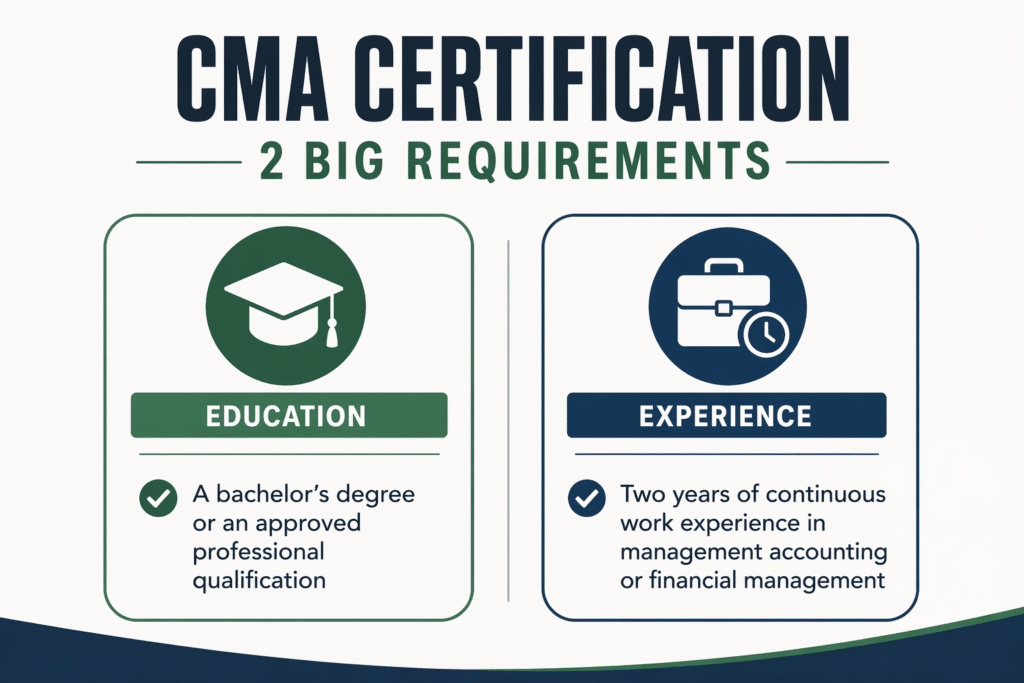
There are also two big certification requirements to keep in mind:
- Education: A bachelor’s degree or an approved professional qualification
- Experience: Two years of continuous work experience in management accounting or financial management
You also need to pass both parts within a three-year window. And yes, you can take Part 2 before Part 1 if that works better for your schedule. To pass each part, you need a scaled score of 360 out of 500.
CMA Exam Format, Parts, And Question Types
The CMA exam has two separate parts, and each part is four hours long.
Here’s the format at a glance:
| Exam part structure | Timing | Weight |
|---|---|---|
| 100 multiple-choice questions | 3 hours | 75% |
| 2 case-based questions | 1 hour | 25% |
A key 2026 update: the IMA is replacing traditional essays with case-based questions (CBQs), including formats like numerical entry and drag-and-drop.
You must answer enough multiple-choice questions correctly, at least 50%, to unlock the CBQ section. Once you leave the MCQ section, you can’t go back.
Part 1 focuses on planning, performance, reporting, controls, and analytics. Part 2 covers analysis, corporate finance, ethics, risk, and investments.
CMA Exam Costs, Registration Fees, and Testing Windows
CMA exam costs can change, so I always recommend checking the latest pricing directly with the IMA before registering. In general, candidates should expect a mix of:
- IMA membership fees
- CMA program entrance fees
- exam registration fees for each part
That means the total cost is more than just paying to sit for the test once.
As for timing, the CMA exam is offered in three testing windows each year:
- January/February
- May/June
- September/October
You can take the exam at a Prometric testing center and, depending on availability and rules, through remote proctoring.
CMA Exam Pass Rates and How The Test Is Scored
Each CMA exam part is scored on a 0 to 500 scale, and 360 is the passing score. The score isn’t a raw percentage. Instead, it’s a scaled score, which helps keep results fair across different exam forms.
The weighting is straightforward:
- Multiple-choice questions: 75%
- Case-based questions: 25%
The exam also uses linear-on-the-fly testing (LOFT), which means candidates get different but comparable versions of the test.
Published pass rates can vary by year and part, so I’d treat them as a rough benchmark, not destiny. For most people, the CMA exam is challenging but very manageable with structured prep and enough practice under timed conditions.
How To Study For The CMA Exam And Build A Realistic Prep Plan
If I were starting from scratch, I’d pick one exam part, one testing window, and one prep course or study system, then keep it simple. Most people get into trouble by collecting materials instead of following a plan.
A realistic CMA exam prep approach looks like this:
- Choose one part first. Don’t split your attention.
- Map backward from test day. Give yourself 8–12 weeks if you’re working full-time.
- Study in small, repeatable blocks. Think 60–90 minutes a day, not heroic cram sessions.
- Do timed MCQs weekly. Speed matters.
- Practice written/case responses. Especially with the 2026 CBQ format change.
And if you’re comparing review providers, this is where solid course reviews can help you avoid wasting both money and momentum. Start with our best CMA review courses breakdown to see how the top providers fit different study styles.
Conclusion
The CMA exam is compact on paper, just two parts, but it covers a lot of ground. If you understand the format, plan for the costs, and study with consistency, it becomes much less intimidating.
Start with one part, one window, and a realistic plan. That’s how people actually pass.
FAQs
The CMA exam, offered by the IMA, is a professional credential for finance professionals aiming for roles like financial analyst or finance manager. It proves expertise beyond bookkeeping to include budgeting, strategy, and decision-making in corporate finance.
To sit for the CMA exam, candidates generally need to join the IMA and enter the CMA program. The degree and work experience requirements must be completed later to earn the certification.
The exam has two parts, each four hours long, with 100 multiple-choice questions (75% of the score) and two case-based questions (25% of the score). A scaled score of 360 out of 500 is required to pass each part, with LOFT ensuring fairness across versions.
Part 1 focuses on financial planning, performance management, reporting, controls, and analytics. Part 2 covers decision analysis, corporate finance, ethics, risk management, and investments, aligning with advanced finance roles.
The CMA exam is offered in three annual windows: January/February, May/June, and September/October. Testing is available at Prometric centers or via remote proctoring, depending on availability and rules.
Leave A Comment