
Becoming a CIA isn’t as popular as a path like the CPA; there are only 220,000 CIAs compared to over 650,000 CPAs.
But in a lot of ways, that’s a major advantage—lots of opportunities, less competition.
Threats to businesses are growing, so naturally, the internal auditing industry is growing right alongside it.
But how do you become a Certified Internal Auditor? And is it worth pursuing?
Here are the facts to help you plan your career.
Key Takeaways
- Three-Part Exam Structure: The CIA exam is split into three parts covering internal audit basics, audit practice, and business knowledge.
- Study Time Adds Up: A structured plan with roughly 60 to 100 hours per part can improve your chances of passing.
- Memorization Is Not Enough: Passing the CIA exam usually takes real understanding of audit standards and concepts, not just repeated question exposure.
- The Exam Is Only One Requirement: Candidates also need to meet education, character, and work experience standards to earn the CIA designation.
- The Credential Can Open Doors: The CIA can strengthen career opportunities in internal audit, risk, and compliance, and may also improve earning potential.
At a Glance: How to Become a Certified Internal Auditor
The short answer is this: you need to qualify through education or experience, apply through The Institute of Internal Auditors, pass the three-part CIA exam, and complete the required work experience and ethics steps. For many people, the full path takes between one and three years, depending on your education, study pace, and whether you already work in audit, risk, or compliance.
Understand What The CIA Credential Is And Whether It Fits Your Career Goals
The Certified Internal Auditor (CIA) is the main professional certification for internal auditors worldwide. It is awarded by The Institute of Internal Auditors and focuses on internal audit, risk management, internal controls, governance, and compliance.
If your goal is to work inside an organization evaluating how well processes, controls, and risk systems function, the CIA is one of the most relevant credentials you can earn. It is not the same as becoming a CPA, which is more closely tied to public accounting, external audit, tax, and financial reporting.
In plain terms, internal auditors help organizations answer questions like:
- Are controls working as intended?
- Are we following laws, policies, and internal procedures?
- Where are the biggest operational or fraud risks?
- How can leadership improve efficiency and oversight?
That makes the CIA especially useful if you want to build a career in:
- Internal audit
- Risk management
- Compliance
- Corporate governance
- Financial controls
- Operational auditing
You do not always need a CIA to land an entry-level audit role. But it can help you stand out, move up faster, and qualify for senior roles later. Many employers view it as proof that you understand the standards and methods used across the profession.
A quick comparison helps clarify where it fits:
| Credential | Best for | Typical focus | Common employers |
|---|---|---|---|
| CIA | Internal auditors and risk professionals | Internal controls, governance, risk, audit engagements | Corporations, banks, healthcare systems, government agencies |
| CPA | Accountants and external auditors | Financial accounting, reporting, tax, regulation | Public accounting firms, corporations, advisory firms |
| CISA | IT audit professionals | Information systems, cybersecurity controls, IT governance | Consulting firms, enterprises, tech-heavy organizations |
If you’re still sorting out the exam side of the path, understanding the Certified Internal Auditor exam can make the decision feel a lot less abstract. Once you know what’s tested, it becomes easier to judge whether this credential matches your strengths.
Meet The Eligibility Requirements And Complete The CIA Certification Process
If you want to become a certified internal auditor, the process is straightforward on paper but longer in real life. You need to qualify, apply, pass all three exam parts, satisfy the experience requirement, and maintain the credential with continuing education.
Meet the eligibility requirements
According to the IIA, you can enter the CIA program if you meet one of several education or experience paths. The most common route is a bachelor’s degree or higher. In some cases, students in their final year can begin the process before graduating.
You may also qualify through relevant professional experience in areas such as:
- Internal audit
- External audit
- Quality assurance
- Risk management
- Compliance
- Internal control
The IIA also recognizes some alternate paths, including candidates with substantial experience or an active Internal Audit Practitioner designation. Requirements can change, so your application should always be matched against the current rules in the IIA certification eligibility guidance.
Apply and schedule the exam
You apply through the IIA’s Certification Candidate Management System. After approval, you can register for exam parts and schedule them through Pearson VUE testing centers.
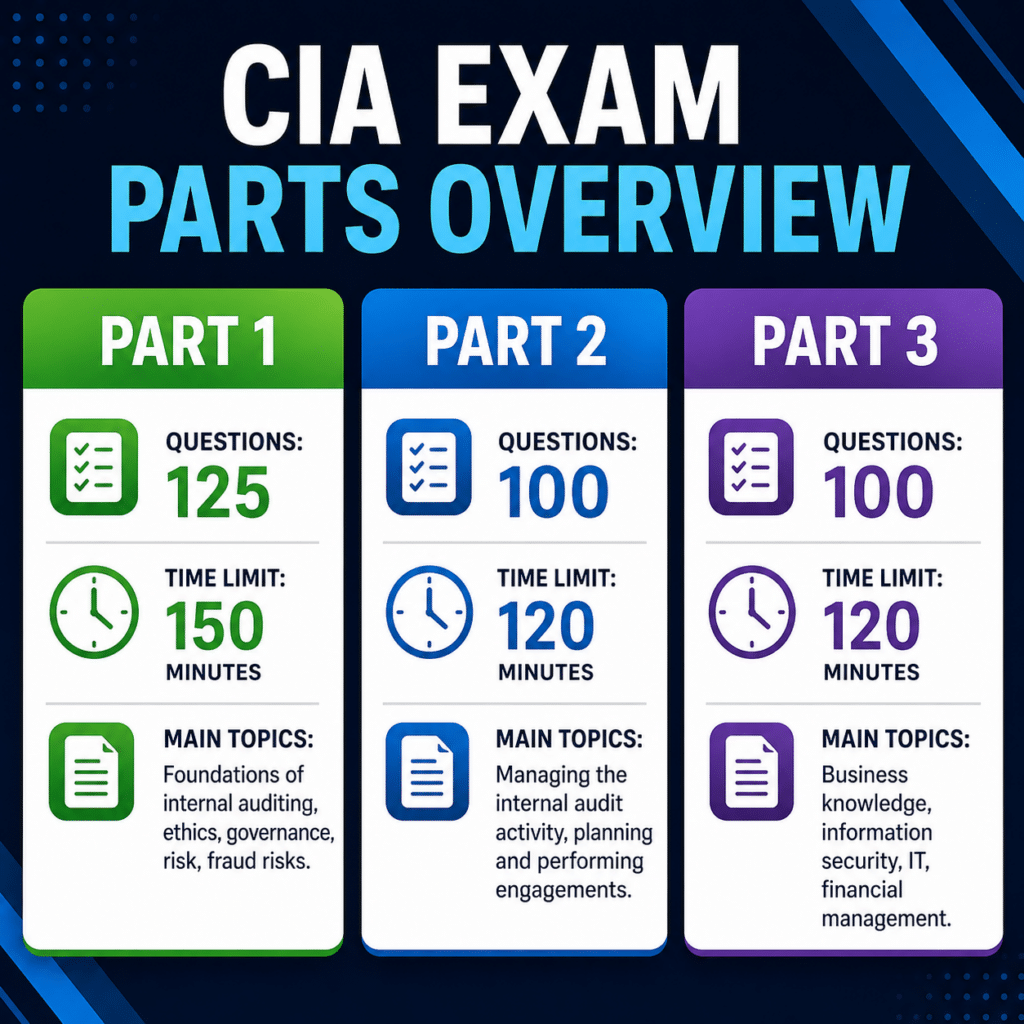
The CIA exam has three parts, all multiple-choice:
| Exam Part | Questions | Time Limit | Main Topics |
|---|---|---|---|
| Part 1 | 125 | 150 minutes | Foundations of internal auditing, ethics, governance, risk, fraud risks |
| Part 2 | 100 | 120 minutes | Managing the internal audit activity, planning and performing engagements |
| Part 3 | 100 | 120 minutes | Business knowledge, information security, IT, financial management |
You need a scaled score of 600 to pass each part. Most candidates do not finish all three overnight. A realistic study timeline is often 9 to 18 months, though it can be shorter if you already work in audit and can study consistently.
Account for the full real-world timeline
This is where many articles get too neat. Passing the test is only part of how to become a certified internal auditor.
Your total timeline may include:
- Education: ~4 years for a bachelor’s degree if you do not already have one
- Exam prep and testing: 9 to 18 months for all three parts
- Experience: 2 years with a bachelor’s degree, or 1 year if you hold a master’s degree, based on IIA rules
- Application and verification: several weeks to a few months depending on documentation and approvals
So the full path can look very different depending on where you start:
- College student: roughly 4 to 6 years total including school and experience
- Bachelor’s degree + relevant job: about 1 to 3 years
- Master’s degree + qualifying experience underway: sometimes around 1 to 2 years
That’s why “how long does it take to become a certified internal auditor?” has no one-size-fits-all answer.
Understand the cost
Your total cost depends on membership status, retakes, and study materials. The IIA charges a program application fee plus separate exam registration fees for each part. Exact pricing varies by category and region, so it is smart to verify current amounts on the IIA certification pricing pages.
A realistic budget often includes:
- Application fee
- Three exam part fees
- Study materials or prep course
- Possible retake fees
- Membership, if you choose member pricing
For many candidates, a practical total range is around $1,000 to $2,500+. On the lower end, you self-study and pass each part once. On the higher end, you add a full prep package and one or more retakes.
If you are comparing study options, a detailed breakdown of the Certified Internal Auditor exam can help you estimate what level of prep you actually need.
Keep the credential active
After certification, you must follow the IIA’s ethics requirements and complete continuing professional education. CIA holders generally report 40 CPE hours per year, according to the IIA’s recertification rules.
A few practical study tips make a big difference:
- Study in exam-part order unless you have a strong reason not to
- Use a question bank, not just reading notes
- Block weekly study time on your calendar
- Take practice exams under timed conditions
- Consider a prep course if you need structure or accountability
Choose the CIA path if you want a focused credential in internal audit and risk. It is a better fit than broader accounting certifications when your target role sits inside an organization’s audit or controls function. Before committing, see how the top providers stack up in our best CIA prep courses.
Conclusion
If you want to become a certified internal auditor, the path ahead is going to combine education, a three-part exam, verified work experience, and ongoing CPE. It’s a smart choice if you want to grow in internal audit, risk, or compliance rather than public accounting.
If you’re ready for the next step, compare study options, choose a prep course, craft your schedule, and start studying.
FAQs
To become a certified internal auditor (CIA), you must meet eligibility criteria through education or experience, apply via The Institute of Internal Auditors, pass the three-part CIA exam, complete required work experience, and comply with ongoing ethics and continuing professional education requirements.
The full path to certification varies from about one to three years for most candidates, depending on prior education, work experience, and study pace. Including education, exam prep, testing, and experience, the entire process can be longer if starting from scratch.
The CIA exam consists of three parts covering fundamentals of internal auditing, ethics, governance, risk, fraud risks, managing internal audit activities, and business knowledge, including IT, financial management, and internal audit function operations.
The CIA is the best fit for professionals focused on internal audit, risk management, compliance, and corporate governance inside organizations. It is more specialized than CPA or CISA credentials, which suit public accounting or IT audit roles, respectively.
Candidates typically need a bachelor’s degree or higher, or relevant professional experience such as internal or external audit, risk management, or compliance. Some may qualify through substantial experience or related credentials like the Internal Audit Practitioner designation.
Leave A Comment