
In the U.S., CMA salaries are often strong, with median earnings near $120,000 and higher total compensation in senior roles.
But the median, and even the average, usually don’t tell the whole story.
How do CMA salaries break down by job title, experience level, and industry?
And perhaps most importantly: if your current plan doesn’t align with the salary level you want, how do you boost your projected income?
If you’re weighing whether the CMA is worth it, this guide breaks down what you can realistically earn, what drives pay up or down, and how to raise your income over time.
Key Takeaways
- Base Pay Is Often Strong: In the body, average CMA base pay sits at $129,961, with median earnings near $120,000 and total compensation often reaching $150,000+ in senior roles.
- Experience Changes the Range: Salary tends to rise with experience, from about $91,500 to $112,975 in the 0–9 year range to roughly $142,252 to $177,467 for professionals with 40+ years of experience.
- Job Title Has a Big Impact: Roles like Financial Reporting Manager and Corporate Controller usually pay far more than positions like Cost Accountant or FP&A Analyst.
- Industry and Employer Type Matter: Large corporations, multinational firms, healthcare systems, and complex manufacturing environments often pay more for CMA-related work.
- Higher Income Usually Comes with Bigger Responsibility: The clearest route to stronger pay is moving into roles with more ownership, leadership, and influence over business decisions.
Average CMA Salary: National Pay Ranges, Median Earnings, and How Certification Affects Income
CMA salaries in the U.S. are typically in the middle to upper range for professionals. According to industry data, the average annual base pay is $129,961, and the median is about $120,000. Total compensation can go over $150,000, especially with bonuses and leadership roles.
Salary ranges are clearer when you consider experience. The IMA’s 2023 U.S. Salary Survey (the latest detailed IMA release cited here) shows that those with 0 to 9 years of experience earn a mean base salary of $99,344. This increases to $122,850 for 10 to 19 years, $145,191 for 20 to 29 years, and $164,473 for 30 to 39 years. In short, CMA pay rises into higher six-figure amounts as you gain experience and move up.
| Years of work experience | Typical CMA salary range |
|---|---|
| 0–9 years | $91,500 to $112,975 |
| 10-19 years | $115,000 to $141,895 |
| 20-29 years | $139,500 to $169,583 |
| 40+ years | $142,252 to $177,467 |
Certification matters because employers often treat the CMA as proof that you understand management accounting, planning, analysis, internal controls, and strategic finance. In practice, that can open the door to better-paying roles in FP&A, controllership, and finance leadership. If you’re still mapping the path, the full CMA certification requirements and the current CMA exam requirements help explain the full process behind the credential.
The timeline is also important when considering salary potential. Getting the credential involves more than just passing a test. You usually need a bachelor’s degree or equivalent to pass both CMA exam parts and to meet IMA experience requirements. As a result, higher earnings are linked to both the certification and the experience you gain along the way.
What Influences CMA Salaries: Industry, Location, Employer Type, And Job Title
Job title has a major impact, too:
| Job title | Typical salary range |
|---|---|
| Cost Accountant | $70,000–$90,000 |
| FP&A Analyst | $70,000–$90,000 |
| Financial Reporting Manager | $110,000–$160,000 |
| Corporate Controller | $150,000–$210,000 |
Industry and employer type can affect pay as much as job title. CMAs working in large companies, complex manufacturers, healthcare systems, and multinational firms often earn more because their work includes budgeting, forecasting, margin analysis, and strategic decision support on a large scale. Smaller employers may pay less, but they sometimes offer broader responsibilities that can help you advance more quickly.
Consider the CMA path if you want a career in corporate finance, planning, or business strategy. It is often a better choice than public accounting if you prefer internal decision-making and operational analysis. However, if you aim for tax, audit, or partnership-track roles, the CMA exam may not match your goals as closely as the CPA route.
One more practical point: your salary often depends on your mix of credentials, education, experience, and communication skills. The CMA is valuable, but employers pay the most when you can turn numbers into business decisions.
How To Increase Your CMA Salary: Career Paths, Promotions, Skills, And Long-Term Earning Potential
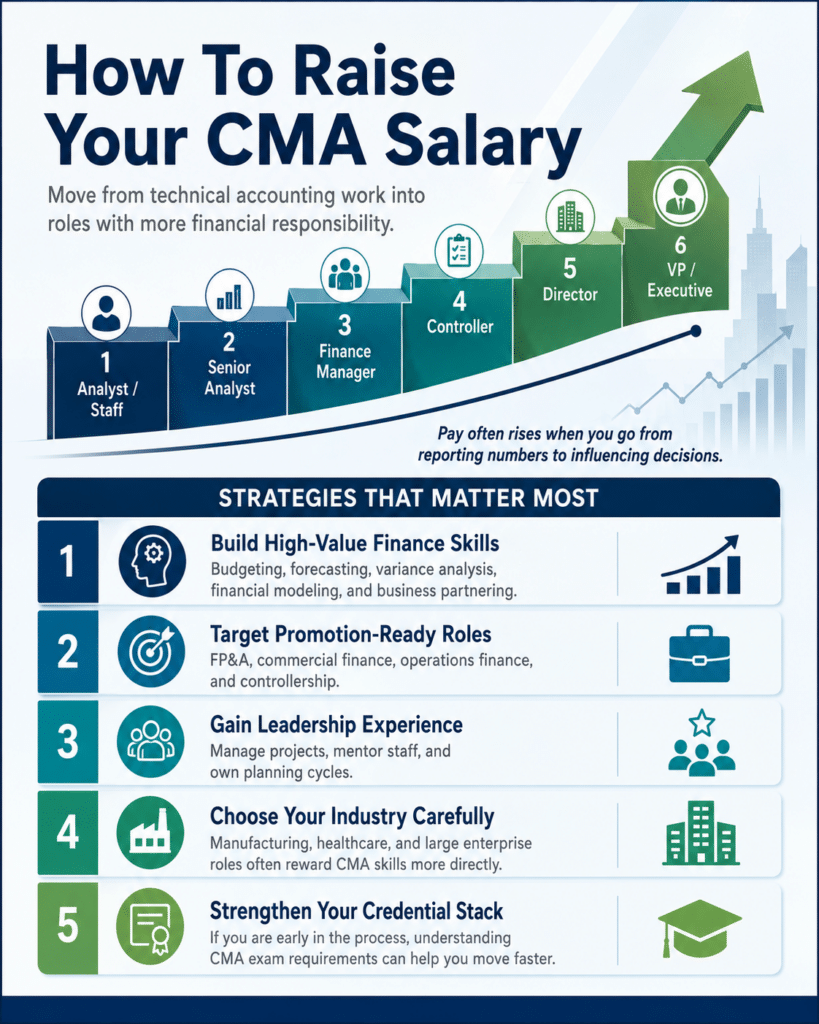
If you want to raise your CMA salary, the best way is to move from technical accounting jobs into roles with more financial responsibility. This often means moving from analyst or staff positions to senior analyst, finance manager, controller, director, and eventually VP or executive roles. In many companies, pay increases when you go from just reporting numbers to actually influencing decisions.
A few strategies tend to matter most:
- Build high-value finance skills. Budgeting, forecasting, variance analysis, financial modeling, and business partnering often pay better than narrow transactional work.
- Target promotion-ready roles. FP&A, commercial finance, operations finance, and controllership often create stronger salary growth than static back-office positions.
- Gain leadership experience. Managing projects, mentoring staff, and owning planning cycles can position you for manager and director jobs.
- Choose your industry carefully. Manufacturing, healthcare, and large enterprise environments often reward CMA skills more directly.
- Strengthen your credential stack. If you’re early in the process, understanding the full CMA exam requirements can help you move faster without wasting effort.
The CMA is especially attractive for long-term earning potential. With over 10 years of experience, professionals can reach the $150,000 to $200,000+ range, especially in controller, strategy lead, or senior finance leadership roles. This does not happen overnight. It usually requires building experience, strong communication skills, and a record of solving business problems.
If your goal is to earn as much as possible, aim for roles with more responsibility. Becoming a finance manager or controller is usually better for salary growth. If you prefer a specialist role with fewer responsibilities and more stable hours, the pay ceiling may be lower.
Final Verdict
The CMA can be a good investment, especially if you want a career in corporate finance rather than public accounting. The credential is helpful, but it is most valuable when combined with experience, good judgment, and roles with more influence in the company. If this matches your goals, the CMA is a smart choice. Get started with one of the top CMA prep courses to help you pass the exam.
FAQs
In the body, average CMA base pay is listed at $129,961, with median earnings near $120,000. Total compensation can rise to $150,000+, especially in senior roles.
Experience has a major impact on pay. In the body, salary ranges rise from about $91,500 to $112,975 for professionals with 0–9 years of experience to roughly $142,252 to $177,467 for those with 40+ years of experience.
The highest-paying roles in the body are Financial Reporting Manager at $110,000 to $160,000 and Corporate Controller at $150,000 to $210,000. Lower-paying examples include Cost Accountant and FP&A Analyst, both listed at $70,000 to $90,000.
The body points to experience, job title, industry, employer type, degree, and communication skills as the biggest drivers of pay. Certification helps, but top salaries usually come when you pair it with stronger experience and decision-making ability.
The clearest path is moving from technical accounting work into roles with broader financial ownership. The body specifically points to building high-value finance skills, targeting promotion-ready roles, gaining leadership experience, and choosing industries that reward CMA skills more directly.
Yes. The body says professionals with 10+ years of experience can move into the $150,000 to $200,000+ range, especially in controller, strategy, and senior finance leadership roles.
Leave A Comment