Accounting is one of the career fields expected to grow faster than average in the coming years, and the CMA designation is one way to advance in the industry.
In fact, around 70% of earners “strongly agree” that the CMA advanced their career.
But the IMA doesn’t hand out this prestigious certification to just anyone. You’ll have to meet the CMA exam requirements—and then, of course, pass the exam.
Stop the endless Google rabbit hole: I did the research for you. Here’s everything you need to know about certified management accountant eligibility before you take the plunge.
Key Takeaways
- You Can Take the Exam Before Finishing Everything: Once you join the IMA, enroll in the CMA program, and pay the required fees, you can register for the exam.
- The Full Credential Has Extra Requirements: To become fully certified, you still need a qualifying bachelor’s degree or approved professional certification + work experience.
- The Exam Has Two Parts: The CMA exam includes two four-hour sections, each with 100 multiple-choice questions and 2 essay scenarios.
- Passing Takes More Than Registration: IMA membership and CMA program enrollment are required before you can sit for the exam.
- The CMA Fits Corporate Finance Roles: The credential is especially useful for professionals working in corporate accounting, budgeting, and cost management.
CMA Exam Requirements: The Basics
You can take the CMA exam if you join the Institute of Management Accountants, enroll in the CMA program, and pay the required fees. To earn the full CMA credential, you also need a qualifying bachelor’s degree or approved professional certification, plus two continuous years of relevant work experience.
Who Can Take The CMA Exam, and Which Eligibility Rules Matter Most
The short version: you do not need to finish every certification requirement before sitting for the CMA exam. In most cases, you can register once you become an IMA member and enter the CMA program. But to become a certified CMA, you must still complete the full eligibility checklist within the allowed timeline.
Here are the rules that matter most:
- Join the Institute of Management Accountants (IMA)
- Enroll in the CMA program and pay the entrance fee
- Pass both parts of the exam
- Meet the education requirement
- Complete two continuous years of qualifying professional experience
- Finish the education and experience requirements within seven years of passing the exam
That seven-year window is important. It gives students and early-career professionals some breathing room, but it is not unlimited. If you pass the exam and then delay the degree or experience requirement too long, you can run into problems getting certified.
What the CMA exam includes
The CMA exam has two parts. Each part is four hours long and includes:
- 100 multiple-choice questions
- 2 essay scenarios
To move to the essay section, you generally need to answer at least 50% of the multiple-choice questions correctly. Each exam part is scored on a scale of 0 to 500, and 360 is the passing score.
According to the IMA’s official CMA information, Part 1 covers financial planning, performance, and analytics, while Part 2 focuses on strategic financial management. If you want a fuller breakdown of topics and format, this guide to the CMA exam can help you picture what you’re signing up for.
Who usually qualifies to sit for the exam
The CMA path is fairly flexible compared with some licenses that require state board approval before testing. That makes it accessible if you are:
- A college student planning a finance or accounting career
- A recent graduate building experience
- A staff accountant who wants to move into FP&A or corporate finance
- A career changer with a business, economics, or analytics background
- A working professional pursuing advancement into management accounting
But accessibility should not be confused with simplicity. You still need to plan for the full process: membership, exam fees, study time, education verification, and experience documentation.
Timeline and cost expectations
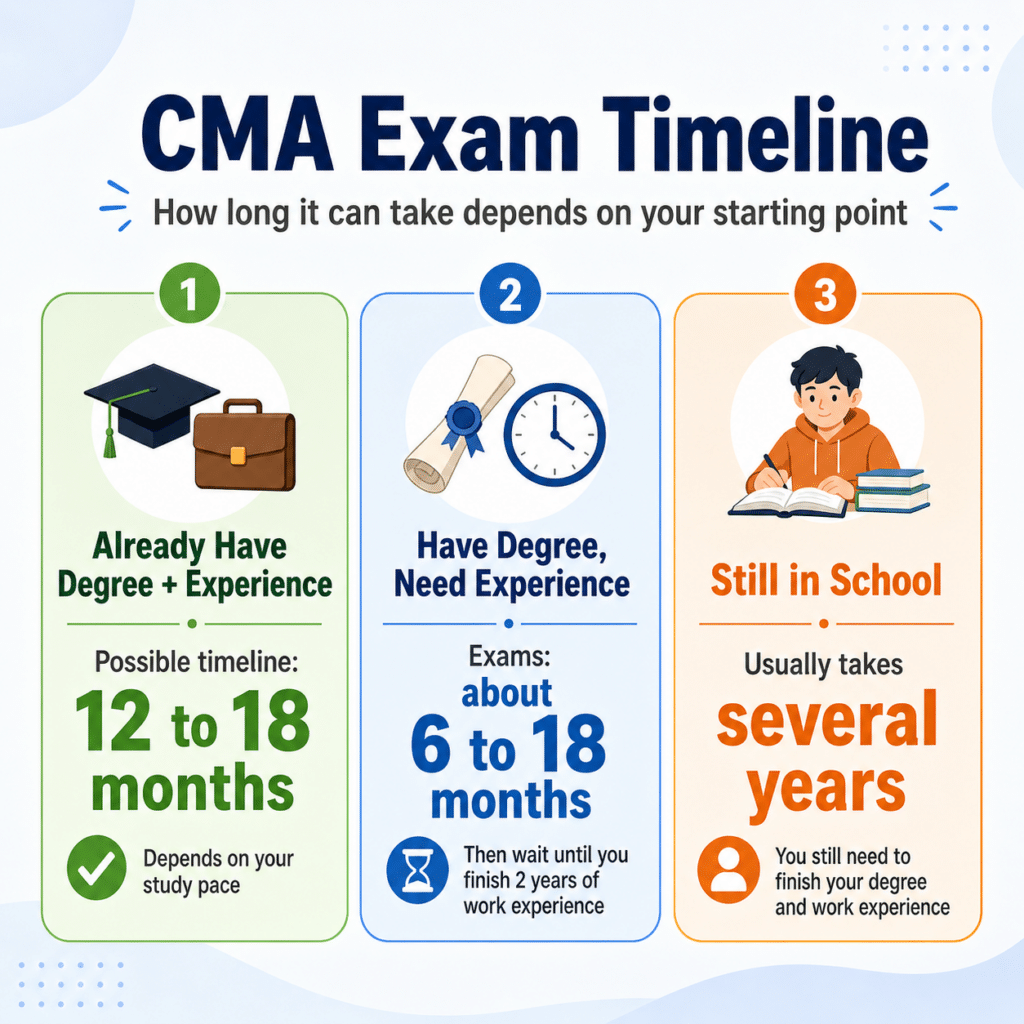
A realistic CMA timeline depends on your starting point.
- If you already have a bachelor’s degree and qualifying experience: you may be able to finish in 12 to 18 months, depending on study pace.
- If you have the degree but not the experience: passing the exams may take about 6 to 18 months, then you’ll wait until you complete the two years of work experience.
- If you are still in school: the full path usually takes several years, because your degree and work history still need to be completed.
Costs vary, but candidates usually pay for:
- IMA membership dues
- CMA entrance fee
- Exam registration fees for Part 1 and Part 2
- Study materials or a prep course
In other words, you can start the CMA journey early, but full certification follows the complete path, not just the exam day.
How Education, Experience, And Membership Requirements Work
The biggest source of confusion around CMA exam requirements is this: passing the test is only one part of becoming a CMA. The credential combines membership, education, exam performance, and work experience.
Membership and program enrollment
Before you can register for the exam, you need an active IMA membership, and you must enter the CMA program. The IMA manages the certification, not a state board, which keeps the process more centralized than something like the CPA.
For many candidates, that’s the first practical step. If you are comparing the broader process, this overview of CMA certification requirements lays out the certification path from start to finish.
Education requirement
To earn the CMA designation, you generally need a bachelor’s degree from an accredited school or an approved professional certification accepted by the IMA. The degree does not have to be in accounting. Finance, business, economics, and other fields can still qualify.
That flexibility is one reason the CMA appeals to career changers and business professionals. If your degree is outside accounting, you can still pursue the CMA as long as the institution and credential meet IMA standards.
Approved alternatives may include certain professional designations, but you should verify eligibility directly through the IMA’s CMA handbook and related certification policies before relying on an exception.
Experience requirement
You need two continuous years of full-time professional experience in management accounting or financial management. Qualifying work often includes roles such as:
- Financial analyst
- Budget analyst
- Cost accountant
- Staff accountant with management accounting duties
- Internal auditor in relevant finance functions
- Controller or assistant controller
- Finance manager
The work must involve judgment and application of accounting or finance principles. Routine clerical work, pure bookkeeping support, and internships typically do not count.
Part-time experience may count if it meets IMA rules. In general, 20 hours per week can be converted on a 2:1 basis, meaning two years part-time at that level may equal one year full-time. That said, exact acceptance depends on the nature of the work and proper documentation.
A side-by-side look at the core requirements
| Requirement | What you need | Can it be completed after the exam? |
| IMA membership | Active membership | No, needed before registration |
| CMA program enrollment | Pay entrance fee and join program | No, needed before registration |
| Exam | Pass Part 1 and Part 2 | No, this is the exam itself |
| Education | Bachelor’s degree or approved credential | Yes |
| Experience | 2 continuous years of qualifying work | Yes |
| Completion window | Finish education and experience within 7 years of passing | Applies after exam passage |
Conclusion
The core CMA exam requirements are straightforward once you separate exam eligibility from full certification: join the IMA, enroll in the program, pass both exam parts, and complete the degree and experience requirements within seven years.
The companion piece on CMA certification requirements focuses on the eligibility side.
If the CMA matches your career direction, your next best step is comparing study options and exam structure so you can build a realistic plan and move forward with confidence.
Get started with one of the top CMA prep courses today and be on your way to a new career.
Frequently Asked Questions
To take the CMA exam, you must join the Institute of Management Accountants (IMA), enroll in the CMA program, and pay the required fees. You do not need to complete your education or work experience before sitting for the exam.
You need a bachelor’s degree from an accredited institution or an approved professional certification accepted by the IMA. Your degree does not have to be in accounting; fields like finance, business, or economics also qualify.
CMA certification requires two continuous years of full-time work experience in management accounting or financial management roles. Part-time experience may count toward this if it meets the criteria. Experience must be completed within seven years after passing the exam.
The CMA exam has two parts, each four hours long, including 100 multiple-choice questions and 2 essay scenarios. Part 1 focuses on financial planning, performance, and analytics; Part 2 covers strategic financial management. A passing score is 360 out of 500 for each part.
Yes, you can take the CMA exam as soon as you join the IMA and enroll in the CMA program, even if you are still completing your degree or lack full work experience. However, you must complete all requirements within seven years to earn certification.
Leave A Comment