
Two parts, registration steps, fees, study hours, and testing windows…
There’s a lot packed into the CMA exam before you even sit down to take it.
And with financial managers ranking among the most satisfied workers in the U.S. (according to the IMA), it makes sense to understand how this exam fits into that career path.
I’m breaking down what the CMA exam covers from recent exam changes, how it works, what it costs, and what you need to know before you register.
Key Takeaways
- Exam Format: The CMA is split into two main parts.
- Question Style: Expect both multiple-choice and written scenarios.
- Cost: Fees can add up before prep materials.
- Study Time: Most candidates need a serious study plan.
- Career Fit: The CMA is best for corporate finance and management accounting paths.
The CMA Exam Sections & How It Is Structured
The CMA exam has two parts, and both are built around real business decision-making. Instead of only testing definitions, it checks whether you can use accounting and finance concepts in practical scenarios.
Each Part Includes:
- 100 multiple-choice questions: completed in 3 hours
- 2 essay/case scenarios: completed in 1 hour
- Score needed to pass: 360 out of 500
- Score weight: MCQs count for 75%, essays count for 25%
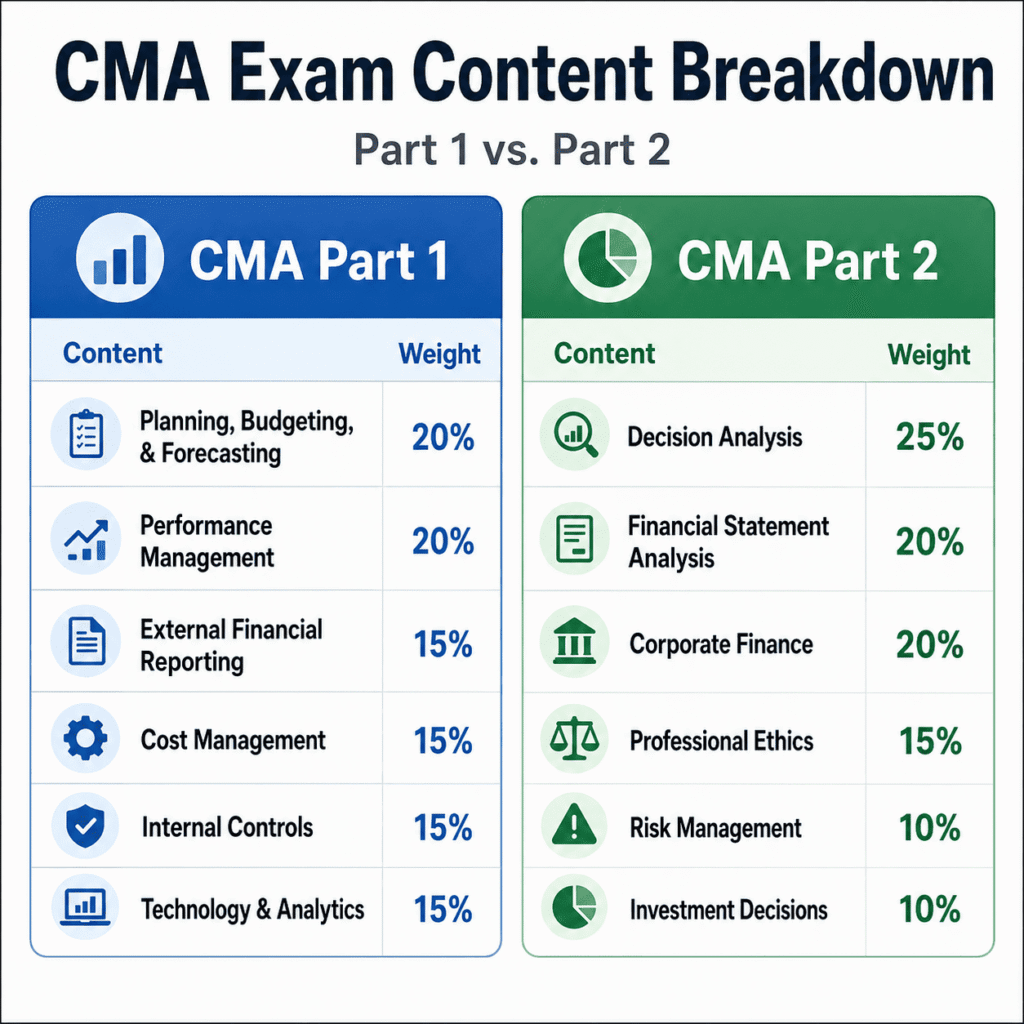
CMA Exam Content Breakdown
Here’s a quick look at what each CMA exam part covers and how much each topic counts toward that section.
| CMA Part 1 Content | Weight | CMA Part 2 Content | Weight |
| Planning, Budgeting, & Forecasting | 20% | Decision Analysis | 25% |
| Performance Management | 20% | Financial Statement Analysis | 20% |
| External Financial Reporting | 15% | Corporate Finance | 20% |
| Cost Management | 15% | Professional Ethics | 15% |
| Internal Controls | 15% | Risk Management | 10% |
| Technology & Analytics | 15% | Investment Decisions | 10% |
Part 1 is more about planning and performance, while Part 2 leans more into finance, strategy, and decision-making.
What Makes The CMA Exam Difficult?
The CMA exam is tough because it tests application, not just memorization. You have to read scenarios, manage your time, pick the best answer, and explain your reasoning clearly.
The hardest parts are:
- Broad topics that overlap
- Heavy time pressure
- Essay responses that need clear logic
- A mix of accounting, finance, and business judgment
That’s why the CMA is usually a better fit for people interested in management accounting, FP&A, corporate finance, and internal business decisions, rather than tax or audit-heavy work.
CMA Exam Costs, Eligibility, & What Registration Involves
The CMA exam cost depends on your membership category, but in most cases, you’ll pay for three things: IMA membership, the CMA entrance fee, and an exam fee for each part. For many candidates, the full cost lands in the roughly $1,300 to $1,800+ range, depending on whether you qualify for student or academic discounts.
Who’s Eligible for the CMA Exam
You can usually start the CMA exam process before meeting CMA exam requirements, as well as the experience needed, but passing the tests is not the whole deal.
To earn the full CMA credential, you’ll need to:
- Become an active IMA member
- Join the CMA program
- Pass both CMA exam parts
- Have a bachelor’s degree or approved equivalent
- Complete two years of relevant work experience
That last part matters. You may be able to sit for the exam first, but you won’t be fully certified until the CMA education and experience requirements are met.
What Registration Involves
Registration is pretty simple:
- Join IMA
- Pay the CMA entrance fee
- Register for Part 1, Part 2, or both
- Schedule your exam through Prometric
- Take the exam during an open testing window
💡 Pro Tip: Before you register, make sure you understand the full CMA certification path — not just the exam part. The experience requirement is easy to underestimate.
How To Study And Improve Your Chances Of Passing
Treat the CMA like a skills exam, not a memorization test. Formulas matter, but practice is what makes the material click.
- Build a Study Timeline: Plan for 150 to 170 hours per part. Take one part at a time if you work full-time or need a slower pace. Move faster only if you already have a strong accounting or finance background.
- Sample Weekly Study Flow: Learn one topic → drill 30 to 60 MCQs → review missed answers → write 1 to 2 short essay responses → finish with a mixed quiz.
- Focus on High-Value Topics: Spend extra time on budgeting, performance management, cost management, decision analysis, financial statement analysis, and corporate finance since these areas carry more weight and connect to other exam concepts.
- Try Extra Help From a Course: One of the top CMA prep courses can help with pacing, question banks, essay practice, and full-length mocks. At minimum, take 2 timed practice exams per part, review wrong answers twice, and practice written responses under time pressure.
Know What Passing Can Mean For Your Career
The CMA is one of those credentials that can actually move you out of basic accounting work and into higher-level finance roles where you’re involved in budgeting, strategy, forecasting, business decisions, and performance analysis instead of just tracking numbers all day.
A lot of people use it to move toward careers in:
- FP&A
- Corporate finance
- Finance management
- Cost accounting
- Business analysis
And yeah, the salary jump potential is part of the appeal, too. BLS reports median pay around $81K for accountants and auditors and about $161K for financial managers in the U.S.
💰Important Note: If you want a closer look at role-specific pay trends, CMA salaries can help you compare likely outcomes.
Bottom Line
The CMA can be a really strong fit if you’re more interested in budgeting, forecasting, strategy, performance analysis, or corporate finance than tax or audit work. The exam is challenging, but the path feels a lot less overwhelming once you understand the structure and what it’s actually preparing you for.
The biggest thing is going in with a realistic study plan. Consistency, good prep materials, and timed practice usually matter way more than trying to cram everything at the last minute.
FAQs
The CMA exam consists of two parts, each lasting four hours with 100 multiple-choice questions and two essays or case-based scenarios. Multiple-choice questions account for 75% of the score, and essays or case-based tasks 25%. A scaled passing score of 360 out of 500 is required for each part.
To be eligible, candidates must be active IMA members, join the CMA program, pass both exam parts, hold a bachelor’s degree or equivalent, and complete two years of relevant professional experience in management accounting or financial management.
The total cost usually ranges from $1,000 to nearly $2,000, depending on membership category and discounts. This includes IMA membership, the CMA entrance fee, and exam fees for each part. Additional costs may apply for review materials or retakes.
Effective strategies include building a realistic study timeline (about 150–170 hours per part), focusing on multiple-choice questions first, emphasizing heavily tested topics like budgeting and financial analysis, practicing essays under timed conditions, and using a structured prep course if needed.
The CMA focuses on management accounting, financial planning, and corporate finance within companies, while the CPA centers on tax, audit, and public accounting. Cost and exam structure differ; reviewing details like the CPA exam cost can help determine which credential fits your career goals better.
Leave A Comment