
Enrolled agent salaries can vary widely, but the bigger story is how earning potential grows over time—and what actually drives it.
With increasing tax complexity, demand for qualified tax professionals is creating more opportunities than ever.
So what can aspiring enrolled agents really expect to earn, and how do they increase their income over time?
After reviewing salary data and industry trends, this guide breaks down average earnings, what impacts your pay, and how to move from entry-level income to higher earning potential. Whether you’re just starting out or looking to grow your tax career, this will help you understand what to expect and how to get there.
Key Takeaways
- Experience Shapes Earnings: Enrolled agents usually earn more as they build experience and move into higher-level roles.
- Location Influences Pay: Salaries can vary a lot depending on where you work, especially in higher-cost markets.
- Employer Type Makes a Difference: Private firms and private practice often offer stronger earning potential than government roles.
- Specialization Raises Value: Skills like IRS representation and complex tax work can help increase income.
- Long-Term Growth Is Stronger in Niche Roles: Specialized tax paths often offer better upside than basic tax prep work.
Enrolled Agent Salaries: Average Annual Pay
Enrolled agent salaries vary by source, but most current estimates cluster in a pretty tight band. ZipRecruiter reports an average annual pay of $72,507, while Indeed lists $71,733. Other industry sources, including Becker and Gleim, place the average close to $72,000 as well.
That makes a fair benchmark for enrolled agent salaries in the US, roughly $70,000 to $72,000 per year. For job seekers, that’s a more practical number than cherry-picking the highest estimate online.
Here’s how the most cited figures compare:
| Source | Reported annual pay | Notes |
| ZipRecruiter | $72,507 | Broad market estimate: top earners around $120,500 |
| Indeed | $71,733 | Based on listed salaries and job data |
| BLS (Tax examiner/tax collector category) | $59,740 | Broader occupation group, not EA-only |
Those lower numbers need context. The Bureau of Labor Statistics does not track enrolled agents as a standalone occupation. Instead, EA-related work often gets grouped into broader tax roles, which can pull averages down. You can review that broader benchmark in the BLS data for tax examiners and collectors.
That’s why you’ll often see two different stories online: one based on EA-specific market estimates and another based on wider government or tax administration categories. Both are useful, but they answer slightly different questions.
In practical terms, many EAs fall into these rough salary bands:
- Entry-level or lower-paying roles: $50,000 to $60,000
- Typical market range: $52,500 to $81,000
- Solid mid-career earnings: $70,000 to $95,000
- Top earners: $100,000 to $120,500 or more
If you’re trying to decide whether this career is worth it, the answer is often yes if you want a tax credential with a shorter path than many accounting routes. To become an enrolled agent, you do not need a bachelor’s degree in every case, and that lower barrier can improve return on investment.
But salary growth is not automatic. Two EAs can hold the same credential and earn very different incomes. The biggest differences come from experience, geography, employer type, and the kind of tax work you handle.
What Affects Enrolled Agent Salaries The Most
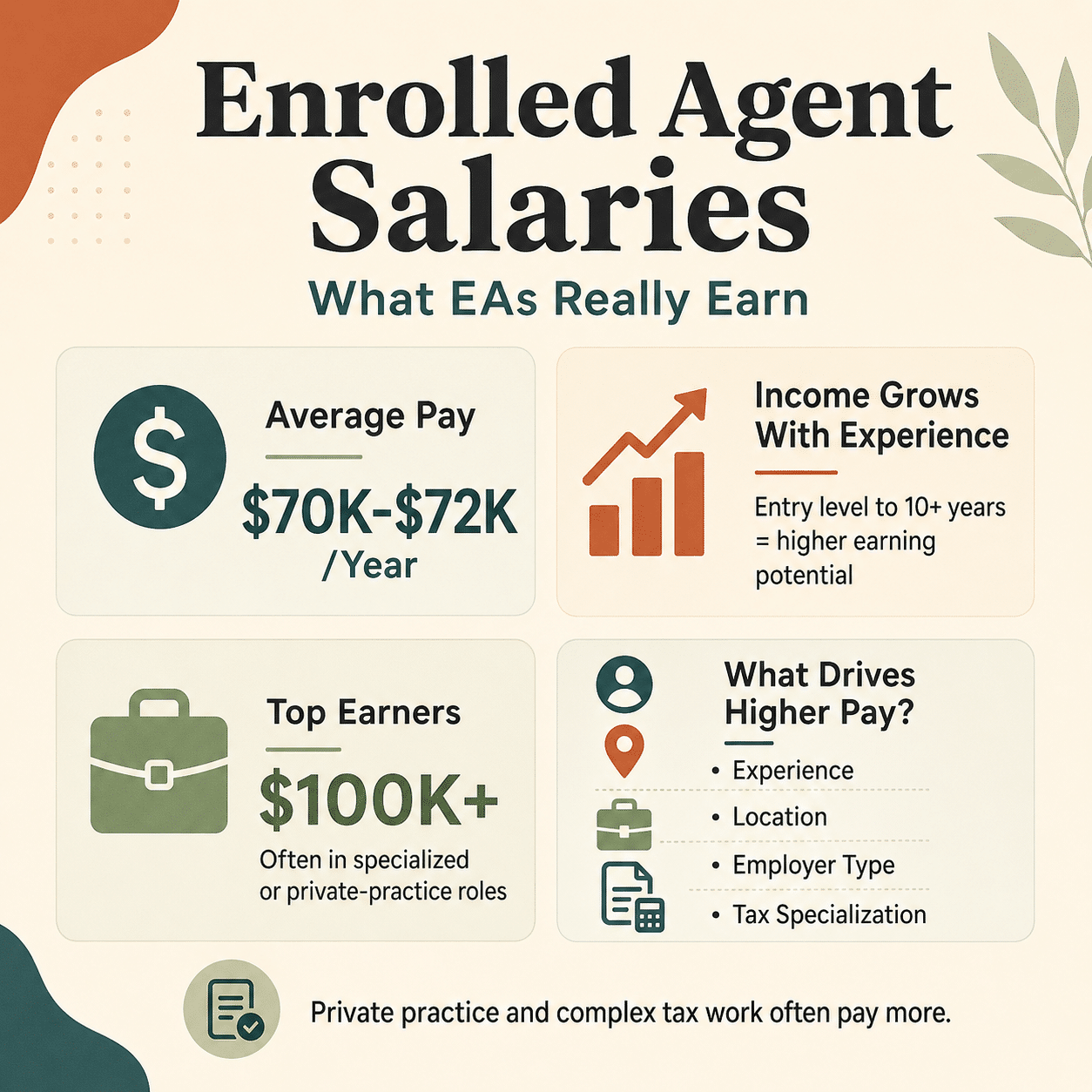
The biggest driver of an enrolled agent’s salary is experience. The credential matters, but employers and clients usually pay more for someone who can handle complex returns, IRS notices, audits, and representation without much supervision.
Some market estimates show a steep climb as experience builds:
- Entry level: about $25,000 to $50,000 in lower-paying roles, though some postings start much higher
- 1 to 3 years: around $84,000
- 4 to 6 years: around $94,000
- 7 to 9 years: around $99,000
- 10+ years: around $111,000
Those figures are best treated as directional, not guaranteed. Still, the pattern is consistent: once you’ve spent years solving tax problems, your value rises fast.
Location also matters. Higher-paying markets tend to have a higher cost of living, more business clients, and more demand for tax specialists who can manage complicated filings.
Employer type is another major factor. Government positions can offer stability and benefits, but private firms, advisory businesses, and independent practices often have more upside. Experienced EAs in firms or private practice can exceed $100,000.
Here’s the clearest way to compare the main salary drivers:
| Factor | Lower end | Higher end | Why it changes pay |
| Experience | $25,000 to $60,000 | $99,000 to $111,000+ | Complex case handling and client trust increase over time |
| Location | Around $54,000 | Around $82,000+ | Local demand and cost of living affect compensation |
| Employer type | Around $50,402 | $100,000+ | Government roles often pay less than private practice |
| Service mix | Basic returns | Representation, planning, business tax work | Higher-value services command better rates |
If your goal is higher pay, the best moves are usually pretty specific:
Build specialized tax skills
EAs who handle IRS representation, audits, collections issues, and multi-entity tax work often earn more than those focused only on simple individual returns. The credential gives you federal practice rights, but your income grows when you use them.
Choose your work setting carefully
A small tax office can be a great starting point, but compensation may flatten if your work stays limited. Larger firms, specialty tax practices, and self-employment can offer more room to increase revenue.
Increase client value, not just hours
An EA who prepares a high volume of basic returns may earn less than one who solves difficult problems for business owners. That’s especially true if you eventually work independently. Self-employed EAs can earn above $100,000, but that usually comes after building expertise and a client base.
Understand the full path before you expect top pay
This is where people get tripped up. Becoming an EA is faster than becoming a CPA in many cases, but your salary ceiling still depends on real experience. The full timeline includes studying for and passing the enrolled agent exam, applying for enrollment through the IRS, passing the suitability check, and then building hands-on tax experience.
For many candidates, that means:
- Exam prep and testing: often several months
- IRS enrollment process: additional processing time after passing
- Meaningful salary growth: usually 2 to 5+ years of work experience
So, what should you choose?
- Choose the EA path if you want a tax-focused credential with a relatively accessible entry path and solid upside.
- An enrolled agent’s salary is better if you plan to build specialized tax skills rather than stay in basic bookkeeping or general admin roles.
- A private practice route is better if you want the highest earnings potential and are comfortable developing clients.
- A government role is better if you value stability, benefits, and predictable compensation more than top-end pay.
One more point: salary data for EAs can look messy because titles vary. Some jobs pay for “tax analyst,” “tax preparer,” or “senior tax specialist” work even when the EA credential is part of the value. So when you compare job posts, look beyond the title and focus on the actual duties, client type, and case complexity.
If you’re still early in the process, understanding how to become an enrolled agent helps you connect the credential to the long-term income path, not just the exam itself.
Conclusion
Enrolled agent salaries are strong for a tax credential that does not always require the same upfront education path as other accounting careers. Most EAs earn around $70,000 to $72,000, and experienced professionals can move well past $100,000 when they build specialized skills and the right client mix.
If you’re weighing your next step, compare the career path with the enrolled agent exam and related study resources so you can judge the time, effort, and payoff with a clear picture.
Ready to get started? Check out these top EA prep courses and see if you find one that fits your needs.
FAQs
Enrolled agents in the US typically earn between $70,000 and $72,000 annually, according to multiple sources like ZipRecruiter and Indeed. Top earners can make over $100,000 depending on experience and location.
Experience is the biggest salary driver for enrolled agents. Entry-level pay ranges from $25,000 to $50,000, increasing to around $84,000 with 1–3 years, and over $111,000 for those with more than 10 years of experience handling complex tax issues.
Yes, location significantly affects enrolled agent salaries. Salaries reflect local demand and cost-of-living differences.
Enrolled agents can boost earnings by developing specialized tax skills like IRS representation, choosing private practice over government roles, and focusing on high-value clients rather than just preparing basic tax returns.
Passing the enrolled agent exam is a crucial step, but earning a strong salary usually requires several years of work experience. Typically, salary growth happens steadily over 2 to 5+ years after completing the exam and enrollment process.
Government positions, including IRS roles, usually start around $50,000 and offer stability, while private sector or self-employed enrolled agents can earn over $100,000 by handling complex tax work and building a strong client base.
Leave A Comment