
Becoming an enrolled agent might seem straightforward, but it involves more than just passing an exam.
With demand projected to grow 6% from 2018 to 2028, it is one of the fastest ways to build a tax career with federal recognition—no CPA license required.
So what does the process actually look like, from start to finish?
After researching the requirements and real timelines, this guide breaks down what an enrolled agent does, how long it takes to get certified, and what you can expect along the way.
Whether you are exploring a new career path or looking to advance in tax, this will help you understand what it takes and how to get started.
Key Takeaways
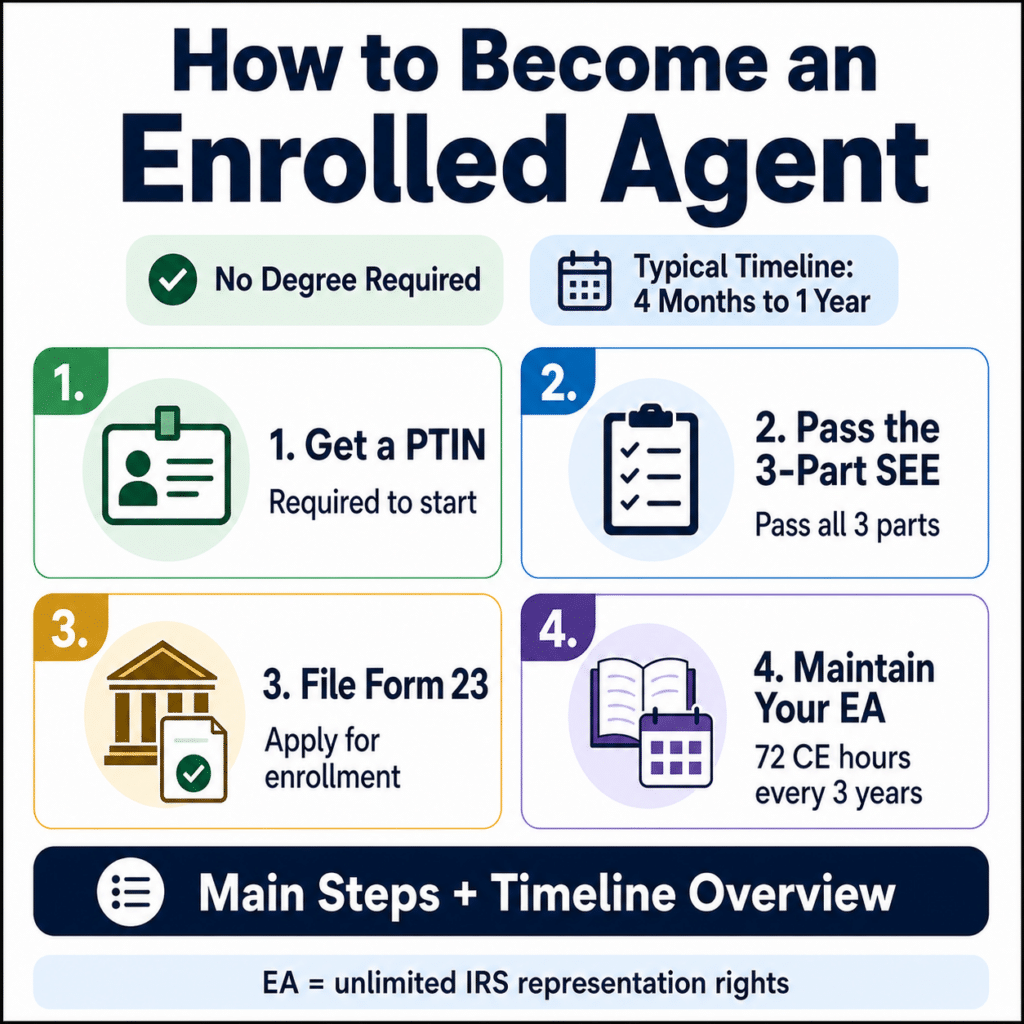
- Becoming an enrolled agent requires obtaining a PTIN, passing all three parts of the IRS Special Enrollment Examination, and applying for enrollment with the IRS.
- The enrolled agent credential allows unlimited representation rights before the IRS, making it valuable for tax professionals focused on tax preparation.
- No college degree is required to become an enrolled agent, making it an accessible and faster path into a tax career compared to becoming a CPA.
- The entire process usually takes between 4 months and 1 year, considering study time, testing, and the IRS suitability review.
- Maintaining the EA credential requires completing 72 hours of continuing education every three years, including ethics training each year.
What An Enrolled Agent Does And Whether This Tax Career Fits You
An enrolled agent, or EA, is a tax professional authorized by the U.S. Department of the Treasury to represent taxpayers before the IRS. EAs have unlimited representation rights, which means they can represent individuals, businesses, estates, and trusts in audits, collections, and appeals. That’s a major difference from unenrolled preparers, who face tighter limits.
In day-to-day work, you might prepare tax returns, respond to IRS notices, help clients fix filing problems, or advise small businesses on tax issues. Some EAs work at accounting firms or tax resolution practices. Others run their own businesses, which is part of the appeal if you want flexibility.
This career often fits you well if you are:
- Detail-oriented and comfortable with rules
- Interested in tax law and problem-solving
- Calm under deadlines, especially during filing season
- Looking for a credential without a four-year degree requirement
- Open to ongoing continuing education
A college degree is not required to become an enrolled agent. That makes the credential attractive for career changers, bookkeepers, admin professionals moving into tax, and students who want a faster route into the field.
It also helps to understand how EA compares with CPA, since many readers weigh both options.
| Credential | Main Focus | License/Credentialing Body | Education Requirement | Typical Timeline |
|---|---|---|---|---|
| Enrolled Agent | Tax preparation and IRS representation | IRS | No degree required | Often several months to about 1 year |
| CPA | Broader accounting, audit, tax, reporting | State boards of accountancy | Usually 150 college credits required | Often several years |
Choose EA if you want to specialize in taxes, want a shorter path, or don’t want to meet CPA education rules. CPA is better if you want broader accounting and auditing options.
The pay can be solid, too. According to the U.S. Bureau of Labor Statistics, the median annual wage for accountants and auditors was $81,680 in the latest available national data from the BLS. EAs are a narrower category, so the Bureau does not publish a separate national median for them. A practical market view is that many EAs fall within a broad range of roughly $50,000 to $90,000+, with experienced tax specialists, firm owners, and representation-focused professionals earning more depending on client base, location, and seasonality. For a deeper breakdown of enrolled agent salaries, it helps to compare a job’s setting, geography, and experience level rather than assuming a single fixed number.
How To Become An Enrolled Agent Step By Step
To become an enrolled agent, you need to meet IRS requirements, pass the required exam unless you qualify through IRS service, and clear a suitability check. Here’s the full real-world path.
If the exam itself is the unknown, my overview of the enrolled agent exam breaks down its three parts.
1. Get a PTIN
Before you prepare federal tax returns for compensation, you generally need a Preparer Tax Identification Number. You apply through the IRS PTIN system. The process is usually quick, often about 15 minutes if your information is ready.
Historically, IRS pricing can change, but the current PTIN fee is $19.75. Always confirm the latest amount through the official IRS PTIN page.
2. Pass the Special Enrollment Examination
Most candidates become enrolled agents by passing the Special Enrollment Examination, also called the SEE. It has three parts:
- Part 1: Individuals
- Part 2: Businesses
- Part 3: Representation, Practices, and Procedures
Each part includes 100 multiple-choice questions, though some are experimental and not scored. You get 3.5 hours per part. Passing requires a scaled score of at least 105, and you must pass all three parts within three years.
The SEE is the core requirement for becoming an enrolled agent without prior qualifying IRS experience.
Exam fees are a meaningful part of the cost. The price has been $267 per part, so all three parts total $801 before study materials, retakes, or travel.
3. Budget for study time and prep costs
This is where many articles get too simplistic. The exam itself is only part of the timeline.
A realistic prep window for most candidates is:
- 2 to 4 months for people with tax experience and steady study habits
- 4 to 8 months for career changers or first-time tax learners
- Longer if you’re balancing work, family, and busy-season demands
Study costs vary a lot. You might spend:
- $0 to $100 using basic or borrowed materials
- $200 to $800 for many self-study review packages
- $800 to $1,500+ for premium prep with lectures, question banks, and support
If you’re comparing routes, choose a lower-cost self-study option if you’re disciplined and already know tax basics. Use one of the best EA prep courses if you need structure, explanations, and a study plan.
4. Apply for enrollment with the IRS
After passing all three exam parts, you submit Form 23, Application for Enrollment to Practice Before the IRS. The enrollment fee is typically $140.
The IRS then reviews your background. This includes a suitability check covering tax compliance and possible criminal issues. In plain English, the IRS wants to confirm that you’ve filed required returns and don’t have conduct problems that would block enrollment.
Processing is often around 60 days, though timing can vary.
5. Know the alternative path
You may qualify without the exam if you have five years of continuous employment with the IRS in a position that regularly interpreted and applied tax law. This is a narrower route, but it matters for some federal employees.
6. Maintain your credential
To stay enrolled, you must complete 72 hours of continuing education every three years, including at least 16 hours each year and 2 hours of ethics annually, under IRS continuing education rules.
What It Costs and How Long It Takes in Total
Here’s the practical picture if you want to become an enrolled agent through the exam path.
| Item | Typical Cost |
|---|---|
| PTIN | $19.75 |
| SEE, all 3 parts | $801 |
| Form 23 enrollment fee | $140 |
| Study materials or prep | $0 to $1,500+ |
| Estimated total | About $961 to $2,460+ |
And the estimated timeline:
- PTIN: Same day
- Exam Prep and Testing: Several months
- IRS Application Review: 2 months
- Full Path for Most People: 4 months to 1 year
That range is more realistic than saying you can become an enrolled agent “in a few weeks.” You might move faster, but only if you already know the material and can pass all three parts quickly.
Final Verdict
If you want to become an enrolled agent, the appeal is clear: no degree requirement, a tax-focused career path, and the ability to represent clients before the IRS nationwide. It’s a practical option if you want a faster route than the CPA path and you’re comfortable building real tax expertise.
Your next step is simple: map out your PTIN, exam, and study budget, then compare prep options that fit your schedule. If you’re weighing exam strategy, a good follow-up is reviewing study resources and course options built around the enrolled agent exam.
FAQs
To become an enrolled agent, first get a PTIN, then pass all three parts of the IRS Special Enrollment Examination within three years, and finally apply for enrollment with the IRS by filing Form 23 and passing a suitability check.
The full process typically takes about 4 months to 1 year, including exam prep, passing all three exam parts, and the IRS application review, which can take around 60 days.
Expect to pay about $20 for your PTIN, $801 for all three parts of the enrolled agent exam, $140 for the enrollment application, plus study materials ranging from free to $1,500 or more, depending on your prep choice.
No, a college degree isn’t required to become an enrolled agent, making it a great option for career changers or those wanting a tax credential without the usual CPA education rules.
Enrolled agents represent taxpayers before the IRS in audits, appeals, and collections. They prepare tax returns, resolve filing issues, and advise on tax matters for individuals and businesses with unlimited IRS representation rights.
Leave A Comment