If you’re pursuing management accounting?
Certification should be in your sights.
After all, management accountants with a CMA certification earn 21% more than their non-certified counterparts, according to global IMA data.
Spending a year or two of study time to get an extra 20 cents on every dollar is a pretty good deal—but first, you’ll have to be eligible to take the exam.
In this guide, I’ll lay out the key requirements you need to know to help you decide if CMA certification is the right path for you.
Key Takeaways
- Know the Main Requirements: To earn the CMA, you need IMA membership, a passing score on both exam parts, the required education, and two years of qualifying work experience.
- You Can Take The Exam Early: You do not need to finish the education requirement before sitting for the exam, but you must submit proof within seven years of passing.
- The Exam Has Two Parts: The CMA exam includes two four-hour sections focused on financial planning and strategic financial management.
- Work Experience Must Qualify: Your experience must be in management accounting or financial management, and part-time work can count if it meets the hour requirement.
- Cost Adds Up Quickly: CMA certification usually costs about $1,500 before prep materials, and most candidates finish the process within 6 to 18 months.
What The CMA Credential Is And Who Should Consider It
The CMA, or Certified Management Accountant, is a certification from the Institute of Management Accountants (IMA). It’s built for people who want to work beyond basic bookkeeping and closer to decision-making.
I usually think of it as the accounting credential for people who want a seat at the strategy table. It focuses on financial planning, performance, analysis, and management.
You should consider it if you want roles like:
- Financial analyst
- Controller
- Finance manager
- Corporate accountant
If you want to move up in business finance, the CMA can absolutely be worth it; it can open doors to high-level positions and an even higher salary.
The Core CMA Certification Requirements At A Glance
At a high level, the CMA certification requirements are simple. Actually doing them takes effort, but the checklist itself isn’t confusing.
Here’s the basic path:
- Join the IMA
- Enroll in the CMA program
- Pass both exam parts
- Meet the education requirement
- Complete 2 years of qualifying experience
- Follow ethics and ongoing CPE requirements after certification
That’s really the whole framework. The tricky part is timing everything well so you don’t drag the process out for years. I’d treat it like a project with deadlines, not a vague someday goal.
Education Requirements: Degrees, Eligible Schools, And Student Pathways
To earn the CMA, you need a bachelor’s degree from an accredited college or university or an approved professional certification.
Accepted alternative credentials can include certifications such as CFA, CIA, CFE, and CTP. If your school is outside the usual accreditation path, IMA may require an evaluation or documentation.
One important detail: you do not need to finish the education requirement before sitting for the CMA exam. That surprises a lot of people.
But there’s a deadline. You must submit proof of education within 7 years of passing the exam. Students can also start early, and some pursue scholarship paths through IMA-supported programs.
Exam Requirements: Membership, Registration, Testing Windows, And Passing Both Parts
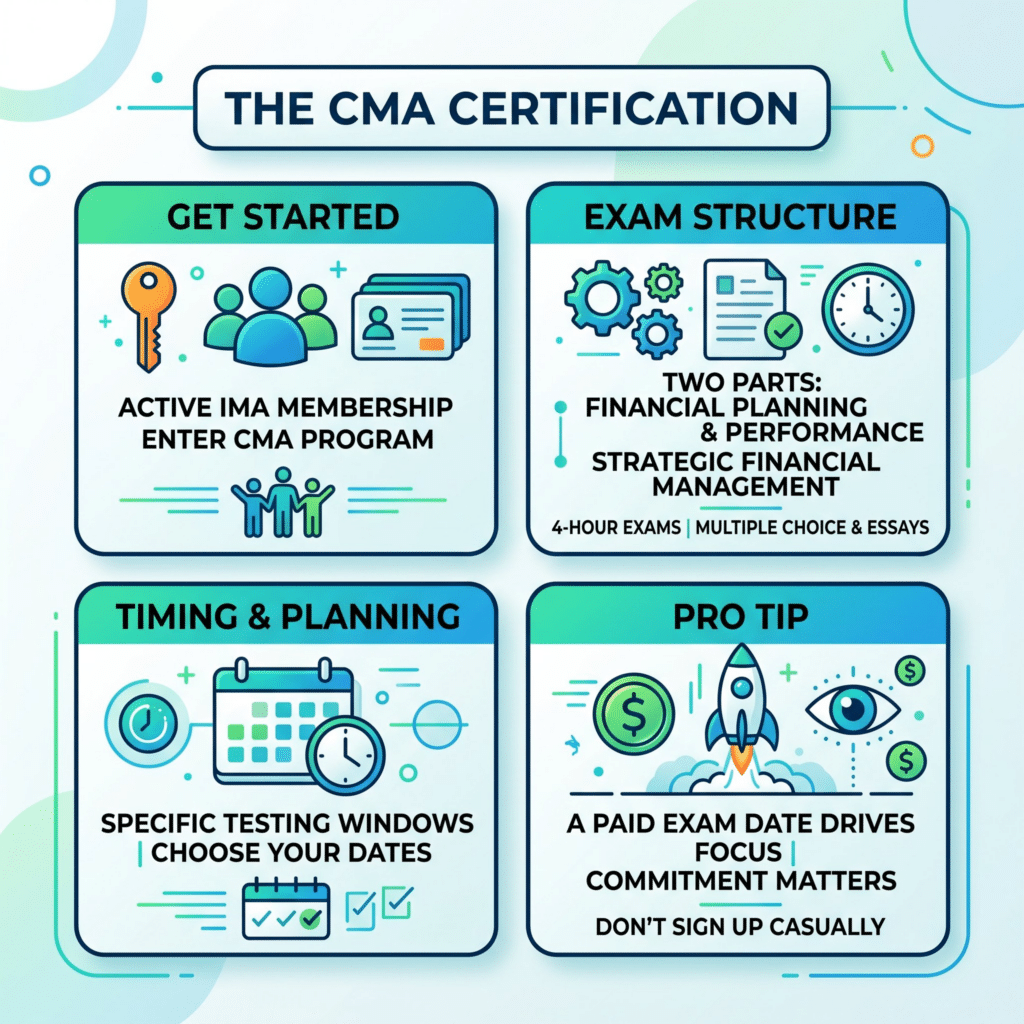
Before you can take the exam, you need an active IMA membership, and you must enter the CMA program. Then you register for each exam part separately.
The CMA exam has two parts:
- Financial Planning, Performance, and Analytics
- Strategic Financial Management
Each part is 4 hours long and includes multiple-choice questions plus essay scenarios.
The CMA exam is offered during specific testing windows throughout the year, so candidates need to plan around those exam periods.
My advice? Don’t sign up casually. A paid exam date has a way of getting your attention very fast.
Experience Requirements: What Counts, What Does Not, And When To Submit Proof
You also need 2 continuous years of full-time work experience in management accounting or financial management. Part-time work can count too if it’s at least 20 hours per week and adds up to the equivalent requirement.
Qualifying work usually involves things like budgeting, forecasting, financial analysis, internal reporting, or decision support.
Some teaching experience counts as well, but only if it’s advanced accounting or finance teaching and at least 60% of the load is above the introductory level.
You can complete the experience before or after the exam, but you must submit proof within 7 years of passing.
What It Costs And How Long It Usually Takes To Become A CMA
The cost is one of the biggest questions, so here’s the clean version.
| Expense | Typical Cost |
|---|---|
| IMA membership | about $295/year |
| CMA entrance fee | about $300 |
| Exam Part 1 | about $495 |
| Exam Part 2 | about $495 |
That puts the core total at roughly $1,585, before study materials. Prep courses can add a lot, depending on what you choose.
As for timing, many candidates finish the exams in 6 to 18 months. You can take longer if needed, but the full certification timeline caps around the 7-year window for completing requirements.
After certification, you’ll need 30 CPE hours each year, including 2 ethics hours.
Conclusion
If you want to grow into higher-level accounting or finance roles, I think the CMA is absolutely worth a serious look.
The requirements are demanding, but they’re doable—especially when you consider the payoff. If you can handle a plan, a budget, and some focused study, this credential can pay off in a big way.
If you’re starting to compare prep options, our best CMA review courses guide breaks down each provider side by side.
FAQs
To become a Certified Management Accountant, you must join the IMA, enroll in the CMA program, pass both exam parts, meet education qualifications, complete two years of relevant work experience, and fulfill ethics and continuing education requirements.
Yes, you can sit for the CMA exam without completing your bachelor’s degree, but you must submit proof of your education within seven years of passing the exam to qualify for certification.
You need two continuous years of full-time or equivalent part-time experience in management accounting or financial management. Teaching advanced accounting or finance (at least 60% above introductory level) also counts.
The CMA exam has two parts: Part 1 covers Financial Planning, Performance, and Analytics, and Part 2 focuses on Strategic Financial Management, including multiple-choice questions and essays.
Most candidates complete the CMA exams within 6 to 18 months, but the full certification process must be completed within seven years, including meeting all experience and education requirements.
Leave A Comment