
If you hold or are pursuing the Certified Management Accountant designation, you know your skill set spans management accounting, cost accounting, financial planning, financial reporting, budgeting, risk management, and financial analysis.
But not all industries leverage those strengths equally.
Some sectors are prime territory for CMAs—stable, complex, well‑structured—while others are chaotic, volatile, or reputation-limiting.
After extensive research, I think I’ve cracked the code for the best firms and industries for CMAs. Below is a breakdown of the best CMA firms, a cluster of specific companies where CMAs tend to thrive, industries that are “maybes”, and industries to avoid, all based on real-world patterns and testimonials from practicing CMAs.
Key Takeaways
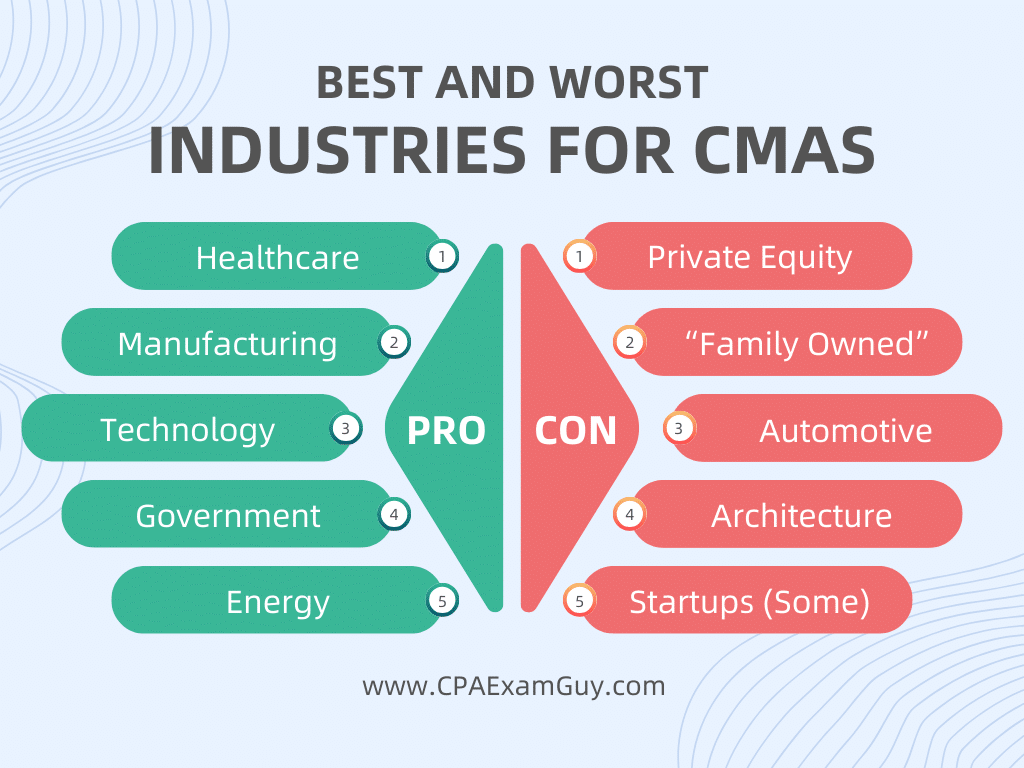
- Best industries for CMAs: Manufacturing, healthcare, tech/SaaS, energy, and government offer strong alignment with CMA skills and long-term stability.
- Tech advantages: CMAs thrive in SaaS and software companies where forecasting, analytics, and strategic finance drive rapid career growth.
- Government benefits: Public sector roles provide an unmatched work-life balance, job security, and predictable budgeting environments for CMAs.
- Energy sector opportunities: Energy and utilities offer high compensation, complex financial modeling, and long-range capital planning work ideal for CMAs.
- Industries to avoid: Private equity–backed firms, family-owned businesses, automotive, and controversial industries can limit growth or reduce résumé appeal.
CMA Career Paths: Best Industries & Firms for CMAs
Healthcare and Pharmaceutical

Companies in this industry—hospitals, health systems, pharmaceutical manufacturers, and medical-device firms—often have complex cost structures with even more complex financial transactions. They rely heavily on budgeting, cost containment, inventory/cost accounting, regulatory compliance, and careful financial reporting. Because of that complexity, CMAs are especially valuable. In fact, some cost‑accountant and cost‑management roles advertised in healthcare are explicitly open to CMA‑certified candidates.
Healthcare organizations need professionals who can analyze financial data, forecast budgets, and help steer spending decisions that impact both operations and patient care, making this a strong environment for CMAs who enjoy meaningful impact and stability. As one testimonial put it:
“I think healthcare industry has great potential for accounting/finance.”
u/Sunshine_Prodigy
Best Healthcare and Pharmaceutical Companies for CMAs
- Pfizer – Known for its global presence and cross-border transactions, Pfizer offers CMAs opportunities in financial reporting, inventory costing, and international compliance.
- Johnson & Johnson – Offers structured finance development programs and roles in FP&A and cost accounting tied to multiple business units (pharma, medical devices, consumer).
- AbbVie – Strong demand for budgeting, forecasting, and cost management talent, particularly in product development and manufacturing accounting.
- Medtronic – Medical device firms like Medtronic value CMAs for tracking cost-of-goods sold, evaluating manufacturing variances, and analyzing operational efficiency.
- Cardinal Health – With vast distribution operations, this is a great fit for CMAs focused on logistics finance, cost allocation, and operational analytics.
Manufacturing, Industrial, and Production

Manufacturing companies, whether producing goods, components, or even pharmaceuticals, often have complicated cost accounting needs: raw materials, labor, overhead, depreciation, inventory, supply‑chain costs. For that reason, cost accountants and management accountants are often in demand in manufacturing.
CMAs in manufacturing help track production costs, analyze variances, and ensure pricing or cost‑control strategies align with long-term profitability. For someone comfortable with numbers, process optimization, and long cycles of production, this industry offers stable demand and a well-defined role.
“I love being in the manufacturing industry. Mostly everyone is very laid back. The company I was with was with was so amazing but the parent company had to ruin it. The place I’m at now is very chill, good pay, and benefits. Plus they’re very flexible with my WFH schedule so I can be with my little one (and mom).”
u/Grootchk13
Best Manufacturing and Industrial Companies for CMAs
- 3M – Offers varied roles in product costing and operations finance across global manufacturing divisions.
- Honeywell – A complex, diversified industrial with cost and variance analysis roles ideal for CMAs.
- Caterpillar – Strong fit for CMAs involved in capital budgeting and margin forecasting for equipment production.
- General Electric (GE) – Rotational programs and financial ops roles involving supply chain and manufacturing finance.
- Whirlpool – Focuses on production accounting, inventory tracking, and cost management for global appliances.
- John Deere – Known for structured finance teams managing factory costing and inventory variance.
Technology, SaaS, and Software

The tech sector, especially SaaS, software firms, and other high-growth companies, increasingly values CMAs who understand financial reporting, forecasting, cost management, and financial insights. Revenue recognition, subscription models, margin analysis, and cost control are often areas where a CMA brings real value. This aligns with industry-wide demand for finance professionals who can interpret complex financial data and support growth strategies.
For CMA jobs that deliver dynamic environments, data‑driven decision making, and working in growth‑oriented businesses, tech/SaaS firms can be great places to advance. Plus, success here can mean exposure to stock options, bonuses, and fast career progression.
Best Tech Firms for CMAS
- Spotify – Known for WLB and finance team culture; CMAs support global forecasting and analytics.
- Nintendo – Stable finance operations in FP&A and tax; excellent for structured, long-term CMA roles.
- Intuit / TurboTax – Great for early-career CMAs; seasonal and year-round opportunities in tax and planning.
- Salesforce – Leverages CMAs in SaaS-based pricing analysis, cost modeling, and business finance strategy.
- Adobe – Focus on recurring revenue, enterprise SaaS, and advanced financial modeling roles.
- ServiceNow – Offers growth-stage FP&A roles focused on subscription revenue and cloud cost structure.
“I heard really good stuff from the people I know who work at Spotify; pay, benefits, lifestyle, culture, WLB, etc. I interviewed with them for a tax position in Stockholm and their HQ is out of this world.”
Reddit User
Government, Public Sector, and Municipal Agencies
Government agencies, public institutions, and sometimes non-profits often need cost accounting, budgeting, financial planning, and reporting. For CMAs who value stability, work-life balance, and meaningful work—and who may prefer structure over volatility—this sector can be a strong match. Many roles involve managing public funds, compliance, cost analysis, and long-term financial planning.
Because public sector organizations often have predictable cycles and less pressure for aggressive profit growth, CMAs can find a stable, steady career path here, especially if they enjoy policy, oversight, and the public service side of finance.
“Government and council jobs usually have the best pay compared to work effort.”
Reddit User
Best Government, Non-Profit, and Public Sector Employers for CMAs
- U.S. Department of Veterans Affairs (VA) – Budgeting and financial oversight roles in healthcare operations.
- State finance departments – FP&A and cost accounting for infrastructure, education, and budgeting.
- County and city governments – Handle departmental budgeting, waste services, and long-term capital planning.
- University finance offices – Cost reporting, grant accounting, and budget planning in higher ed institutions.
- Public hospital systems – Great for healthcare CMAs managing payer mix, reimbursements, and cost tracking.
- NASA / FEMA / DoD – Opportunities in financial planning for scientific and defense-related programs.
Energy & Utilities

Though somewhat less talked about, energy and utility companies tend to have large balance sheets, heavy capital expenditure, significant regulatory oversight, and ongoing cost‑management needs. This makes them fertile ground for CMAs who specialize in cost accounting, forecasting, and financial analysis. Cost control, budgeting for large projects, evaluating long-term investments, and risk assessment are common responsibilities, aligning nicely with CMA skill sets.
For aspiring senior finance professionals, this industry can also offer long-term stability and opportunities to get involved in corporate finance, investment analysis, and strategic planning. Plus, expect a higher average salary as a CMA than in other industries.
Best Energy and Utilities Companies for CMAs
- ExxonMobil – Roles for CMAs in upstream/downstream cost forecasting and investment modeling.
- Chevron – Strategic finance, capital budgeting, and corporate reporting across divisions.
- NextEra Energy – Strong focus on renewable project planning, capital finance, and rate-based forecasting.
- Duke Energy – Opportunities in financial planning for utilities, infrastructure, and regulatory compliance.
- Enbridge – Cross-border cost planning, financial modeling, and multi-asset financial oversight.
- Southern Company – Complex budgeting and regulatory reporting roles in energy delivery.
Hit or Miss Industries for CMA Holders
These industries can work well, but only if the role, team, and leadership align with your personality and risk tolerance.
Startups
- Often offer significant learning and rapid growth.
- But it can be chaotic, under-resourced, and poorly structured.
- Success depends heavily on the direct manager’s and the company’s maturity.
“I’ve worked at a few tech startups and have enjoyed them all. Especially if you get in early and they are successful.”
u/AppearanceWeak1178
“Based on the clients I work for, I’d avoid start-ups as they’ll have a very immature accounting function. You’ll likely learn a ton but as a first step in a career I’d say it’s better to be in a more stable position.”
u/aqphs
Companies (examples — not all good or bad universally)
- Series A–C SaaS firms
- Venture-backed tech companies
- Growth-stage fintechs
- Digital health startups
Big 4 Accounting Firms
- Amazing experience builder; unmatched exposure.
- But hours can be rough, structure varies by group, and WLB is unpredictable.
Big Four Firms for CMAs
- Deloitte
- EY
- PwC
- KPMG
Industries Certified Management Accountants Should Avoid
Based on anecdotal experience, hiring trends, and reputation risks:
Private Equity–Owned Companies
- Extremely high pressure
- Rapid restructuring
- No process stability
- Often chaotic, understaffed, and cost-obsessed
“Private Equity owned/backed companies tend to be circuses with long hours, constant change, no institutional knowledge, and little structure. It can be in any industry but something to watch out for and know what to expect for sure. If it’s not publicly traded or a known startup or family business, it’s likely PE owned.”
u/Jimger_1983
Small / Family-Owned Businesses
- Poor systems
- Overwork + underpay
- Your boss’s wife is the HR manager
- Limited career mobility
“I’m in a small tax firm with a boomer owner. I’m overworked and underpaid. Yet he tries to make it sound like I have the opportunity of a lifetime because one day I can buy him out. Long story short, avoid anywhere small and “family” oriented.”
Reddit User
Automotive
- Inefficient, chaotic processes
- Constant cost pressure
- Difficult environments for strategic finance
“An industry to avoid is automotive. I’m sure some of the large OEMs are good to work for/have good accounting practices but from what I’ve seen from the industry on both the supplier side and OEM side it’s an absolute (mess). Inefficiencies are absolutely everywhere, all of which makes it harder to actually account for what goes on at the business.”
u/aqphs
Architecture / Interior Design Firms
- Volatile demand
- Toxic or aggressive management (per multiple anecdotes)
- High layoffs
- Under-resourced finance teams
“Avoid architecture/interior design. I was in that industry for 20 years and don’t know of any accounting/finance staff who didn’t experience a high level of toxicity and upper management aggression. They also have frequent layoffs and target accountants/finance before technical staff.”
u/Positive_Resistance
Quick Look at CMA Job Fit by Sector
| Industry | Stability | Skill Utilization | Career Growth | Compensation | CMA Fit |
|---|---|---|---|---|---|
| Healthcare/Pharma | High | Excellent | Strong | High | ⭐⭐⭐⭐⭐ |
| Manufacturing | High | Excellent | Strong | High | ⭐⭐⭐⭐⭐ |
| Tech/SaaS | Medium–High | Excellent | Very Strong | High | ⭐⭐⭐⭐⭐ |
| Government | Very High | Good | Moderate | Moderate–High | ⭐⭐⭐⭐ |
| Energy | High | Excellent | Strong | Very High | ⭐⭐⭐⭐⭐ |
| Startups | Very Low–High | High | High (hit/miss) | Variable | ⭐⭐–⭐⭐⭐⭐ |
| Big 4 | Medium | Good | Strong | Medium | ⭐⭐⭐ |
Final Thoughts
CMAs thrive in industries that value strategic financial management, not just bookkeeping. If you want stability, strong compensation, structured environments, and roles where your financial analyst skills and advisory services matter, the best sectors are healthcare, manufacturing, tech/SaaS, government, and energy.
Startups and Big 4 can work for certain personalities. However, private‑equity chaos, family-owned volatility, and certain operational sectors like automotive or architecture often spell frustration or career stagnation.
Your CMA is a strategic credential, giving you invaluable skills and knowledge like portfolio management, investment banking, business process outsourcing, developing financial models, supply chain management, and management consulting. Put it somewhere strategic.
Start your journey to working with one of these firms by studying for the exam with one of the top CMA review courses, passing the exam, and becoming a CMA.
FAQs
Top industries for CMAs include healthcare, manufacturing, tech/SaaS, energy, and government, all of which value cost analysis and strategic finance.
Great firms for CMAs include Pfizer, Johnson & Johnson, 3M, Caterpillar, Spotify, Intuit, Duke Energy, and U.S. government agencies like the VA and DoD.
Absolutely. Government roles often offer job security, predictable budgets, and long-term stability for CMAs focused on public finance or policy.
CMAs should steer clear of PE-backed companies, small/family-owned businesses, automotive suppliers, and controversial industries due to instability or reputational risk.
Large corporations, SaaS companies, manufacturers, and energy firms frequently hire CMAs into roles that require financial insight, planning, and investment analysis.
Leave A Comment