If you want a Certified Internal Auditor’s salary (~$80,000+), you’ll have to pass the CIA exam.
But with three distinct parts to pass, success is a tall order. Especially if you want a clean sweep on your first try.
You’ll have to go deeper: understand the exam structure, eligibility rules, and realistic study timelines.
In this guide, you’ll get a clear breakdown of what the certified internal auditor exam includes, who it makes sense for, how scoring works, and how to prepare in a way that actually improves your odds of passing.
Key Takeaways
- Three-Part Exam Structure: The CIA exam is split into three parts covering internal audit basics, audit practice, and business knowledge.
- Study Time Adds Up: A structured plan with roughly 60 to 100 hours per part can improve your chances of passing.
- Memorization Is Not Enough: Passing the CIA exam usually takes real understanding of audit standards and concepts, not just repeated question exposure.
- The Exam Is Only One Requirement: Candidates also need to meet education, character, and work experience standards to earn the CIA designation.
- The Credential Can Open Doors: The CIA can strengthen career opportunities in internal audit, risk, and compliance, and may also improve earning potential.
What The Certified Internal Auditor Exam Covers And Who Should Take It
The certified internal auditor exam covers the core knowledge expected of internal auditors by The Institute of Internal Auditors. It focuses on internal audit basics, audit execution, and business knowledge, all through multiple-choice questions.
The exam is split into three parts:
| CIA exam part | Main Focus | Question Count | Time Limit |
|---|---|---|---|
| Part 1 | Essentials of internal auditing | 125 | 2.5 hours |
| Part 2 | Practice of internal auditing | 100 | 2 hours |
| Part 3 | Business knowledge for internal auditing | 100 | 2 hours |
What each part covers
Part 1 is the foundation. You’ll see topics like:
- Governance, risk management, and control
- Independence and objectivity
- Due professional care
- Quality assurance and improvement programs
- Fraud risks and basic fraud awareness
Part 2 moves into day-to-day audit work. That includes:
- Planning engagements
- Performing audit procedures
- Documenting work
- Communicating results
- Monitoring outcomes and follow-up
Part 3 is usually the broadest section. It covers business knowledge that supports internal audit, such as:
- Financial management
- Information technology and cybersecurity basics
- Data analytics
- Organizational structure and business processes
- Management and strategic concepts
Because Part 3 pulls from several disciplines, many candidates find it the most unpredictable.
Who should take the CIA exam?
The CIA is a strong fit if you want to build a career in internal audit, compliance, enterprise risk, or controls. It’s often valuable for:
- Audit staff and senior auditors
- Risk and compliance professionals
- Accountants moving into internal audit
- Finance professionals who work with controls or governance
- Students planning an audit-focused career path
If your goal is management accounting, the CMA exam may be a better match. If you want a broader roadmap on how to become a certified internal auditor, the exam is just one part of the process.
Eligibility and the real timeline
To earn the CIA designation, you need more than passing scores. According to the IIA, candidates generally need qualifying education, character verification, and relevant work experience. Many applicants qualify with a bachelor’s degree plus internal audit or related experience, while some students can enter the program before graduation under specific rules.
That’s why the full timeline matters. Passing the certified internal auditor exam may take several months, but earning the credential often takes longer because education, application approval, and work experience all count too.
How The CIA Exam Is Structured, Scored, And Scheduled
The certified internal auditor exam is computer-based and offered through Pearson VUE testing centers. You take each part separately, and most candidates schedule the parts over several months rather than all at once.
Structure and question style
All three parts use multiple-choice questions. There are no essays, task-based simulations, or oral components. That makes the format straightforward, but don’t confuse that with easy. The challenge is speed, judgment, and knowing how the IIA frames audit concepts.
Generally speaking, you’ll have just over one minute to answer each question. So, if you regularly spend two minutes on one item, you’ll feel the pressure fast. Practicing with realistic timing is a non-negotiable for effective preparation.
How scoring works
The CIA exam uses scaled scoring. A passing score is 600 on a scale that runs from 250 to 750, based on IIA reporting. Your final result is pass or fail, even though the score report may show performance by domain.
Public pass rates can vary by source and period, but many prep providers cite average pass rates around the upper-40% range across parts. That’s not a reason to panic. It’s a sign that the certified internal auditor exam rewards real preparation, not casual review.
Scheduling and completion window
Once you’re approved in the certification program, you can register for exam parts and choose testing dates through Pearson VUE. The IIA gives candidates a three-year program window to complete the requirements for the CIA.
That window is helpful, but it can also make procrastination look harmless. For most people, a tighter plan works better.
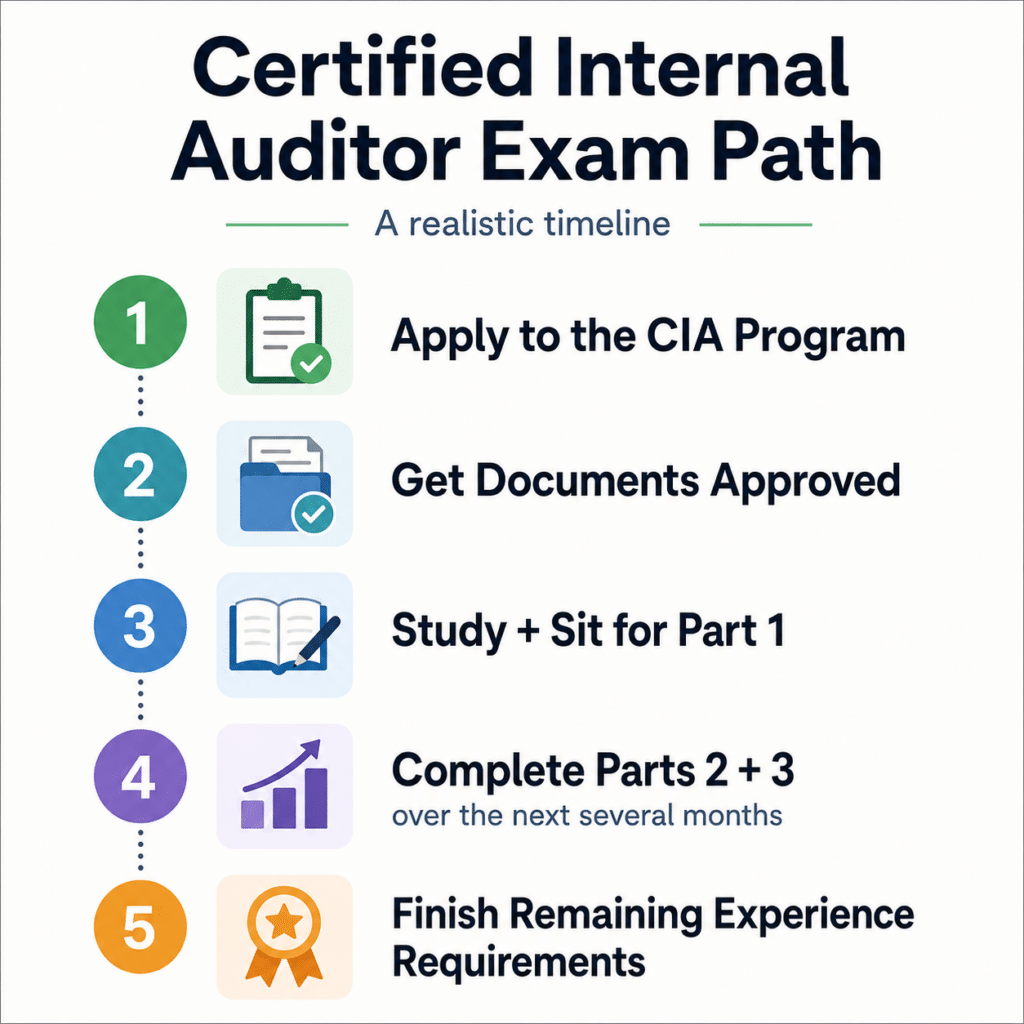
A realistic path often looks like this:
- Apply to the CIA program
- Get documents approved
- Study and sit for Part 1
- Complete Parts 2 and 3 over the next several months
- Finish any remaining experience requirements
If you’re comparing credentials, the certified internal auditor exam is narrower and more specialized than the CPA path. That can make it attractive if you want audit credibility without pursuing a public accounting license.
How To Study For The Certified Internal Auditor Exam And Improve Your Chances Of Passing
The best way to study for the Certified Internal Auditor exam is to follow the syllabus closely, use a question bank consistently, and prepare in the order that matches your background. Most candidates do best with a structured plan rather than trying to cram each part in a few weekends.
Choose the right exam order
For many candidates, Part 1 first makes sense because it builds the core language of internal auditing. After that, many move to Part 2 and leave Part 3 for last.
That sequence usually works well if you already work in audit. But there are exceptions:
- Choose Part 1 first if you’re new to internal audit and need the foundation.
- Choose Part 2 next if your daily work already includes audit planning, fieldwork, or reporting.
- Give Part 3 extra time if finance, IT, or business strategy are weaker areas for you.
Build a realistic study plan
A practical range is 60 to 100 study hours per part, depending on your experience. Some people need less for Part 2 if they already work in internal audit. Others need more for Part 3 because the content is broad.
A solid weekly plan usually includes:
- 5 to 8 study hours spread across the week
- One focused review session for weak topics
- Timed question practice
- Short notes or flashcards for high-miss concepts
If you’re balancing work and family, consistency matters more than marathon sessions. Ninety minutes a day, five days a week, beats one exhausted eight-hour Saturday more often than people admit.
Use review materials strategically
Many candidates use prep providers such as Becker or Gleim alongside the official IIA syllabus. The point is not to collect every resource. It’s to use one main system deeply.
Your prep should include:
- A current review course or textbook
- A large MCQ bank
- Performance analytics by topic
- At least a few full-length, timed practice sessions
For career planning, it also helps to understand how the exam fits into the wider path to become a certified internal auditor. The exam is central, but employers also care about experience and how well you can apply audit judgment on the job.
What improves your odds of passing
Candidates usually improve fastest when they stop reading passively and start practicing actively. That means explaining concepts in your own words, reviewing why wrong answers are wrong, and tracking patterns in your mistakes.
Focus on these habits:
- Study to understand standards and reasoning, not just definitions
- Do timed question sets early, not only at the end
- Revisit weak domains every week
- Avoid overstudying your strongest topics
- Use a prep course if you need structure and accountability
And be honest with yourself. If you keep scoring poorly in a domain, don’t label it a “bad test area.” It’s a study signal. When you’re ready to compare prep options, our best CIA prep courses page covers the top providers head-to-head.
Conclusion
Here’s the bottom line:
The certified internal auditor exam is a focused, respected credential for people who want to build careers in internal audit, risk, and controls. It’s a great choice for internal auditing specialists; just be sure to give yourself enough time for the full path, including eligibility and experience.
FAQs
The CIA exam covers internal auditing fundamentals, including governance, risk management, controls, independence, due professional care, fraud awareness, audit execution, and business knowledge like financial management, IT basics, and strategic concepts.
The CIA exam has three parts with multiple-choice questions: Part 1 has 125 questions (2.5 hours), Parts 2 and 3 have 100 questions each (2 hours). It uses scaled scoring with a passing score of 600 and is reported as pass or fail.
The CIA is ideal for internal auditors, risk and compliance professionals, accountants moving into audit, finance specialists, or students targeting audit careers. It’s best for those focusing on internal audit rather than broader accounting roles.
A structured study plan with 60–100 hours per part, emphasizing active practice with question banks, timed tests, and focused review on weak areas, works best. Starting with Part 1, then Part 2, and Part 3 last, is a common strategy.
While passing the exam parts may take several months, completing the full CIA certification usually takes longer due to education verification, application approval, and required work experience within a three-year window.
Leave A Comment