
The Enrolled Agent Exam can turn tax knowledge into a real professional credential. But first, you have to get through a lot of tax rules, forms, and tricky scenarios.
Fun, right?
According to the IRS FAQs, the exam has three parts with 100 questions each. So while you don’t need a degree or years of experience, you do need a solid study plan.
In this guide, I’ll break down how hard the exam is, what to expect, and how to prepare without trying to memorize the entire tax code.
Key Takeaways
- Three Exam Parts, One Credential: The Enrolled Agent Exam has three separate parts.
- Choose Your Own Order: You can take the sections in any order.
- 100 Questions at a Time: Each part contains 100 multiple-choice questions.
- You Have Three Years: You have three years to pass all three parts.
- Understanding Beats Memorizing: Passing requires knowing how tax rules apply, not just memorizing terms.
Who is the EA Exam Even for?
The Enrolled Agent Special Enrollment Examination, or EA-SEE, is the test most people take to become an enrolled agent.
Enrolled agents are federally authorized tax professionals. They can prepare tax returns and represent individuals or businesses before the IRS during audits, collections, and appeals.
The exam is a good option for:
- Tax preparers who want a higher-level credential
- Accountants who want to specialize in federal taxation
- Career changers interested in tax work
- Professionals who want to represent clients before the IRS
You do not need a college degree or previous tax experience. You will need a valid Preparer Tax Identification Number before scheduling.
After passing, you must apply for enrollment and pass an IRS suitability check. That includes a review of your tax compliance and criminal background. IRS
Enrolled Agent Exam Format and Sections
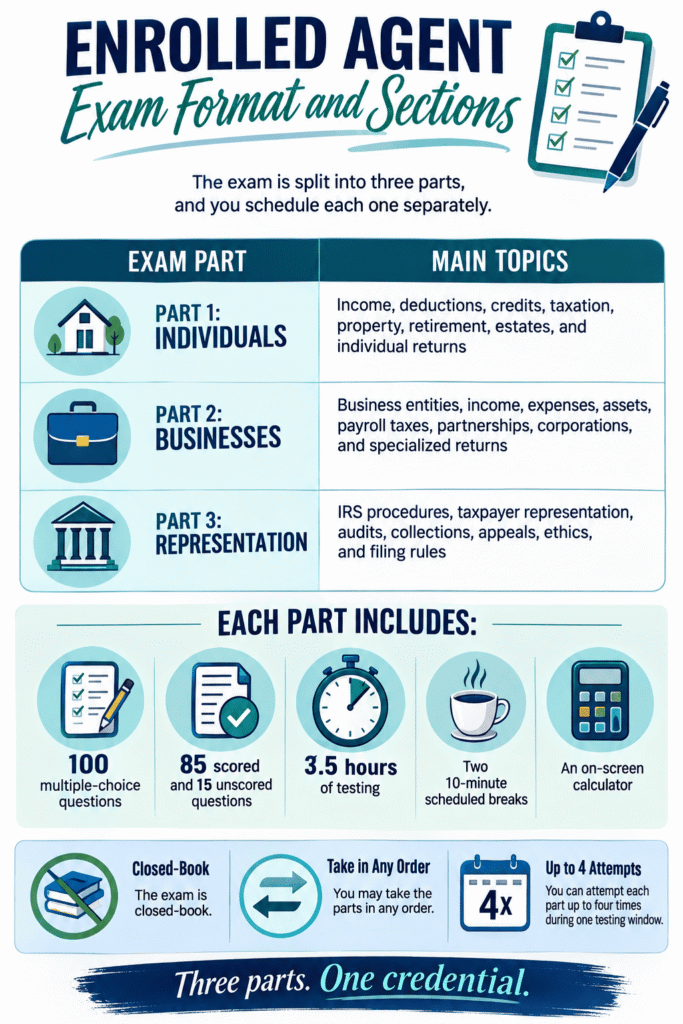
The exam is split into three parts, and you schedule each one separately.
| Exam Part | Main Topics |
|---|---|
| Part 1: Individuals | Income, deductions, credits, taxation, property, retirement, estates, and individual returns |
| Part 2: Businesses | Business entities, income, expenses, assets, payroll taxes, partnerships, corporations, and specialized returns |
| Part 3: Representation | IRS procedures, taxpayer representation, audits, collections, appeals, ethics, and filing rules |
Each part includes:
- 100 multiple-choice questions
- 85 scored and 15 unscored questions
- Three and a half hours of testing
- Two scheduled 10-minute breaks
- An on-screen calculator
The exam is closed-book. You may take the parts in any order and attempt each part up to four times during one testing window.
How Difficult Is It?
The Enrolled Agent Exam is hard, but manageable when you study one part at a time. Estimated EA exam pass rates range from about 61% to 85%, with Part 2: Businesses generally considered the most challenging.
What tends to trip people up:
- Small Details: One date, dollar amount, or filing status can change the answer.
- Business Tax Rules: Part 2 covers several business types, each with different rules.
- Tax Exceptions: You need to know when the normal rule does not apply.
- Long Questions: Some include extra information you have to sort through quickly.
You’ll need a scaled score of 500 in order to pass each part. Tax experience helps, but focused preparation can make up for starting from scratch.
How to Pass the Enrolled Agent Exam
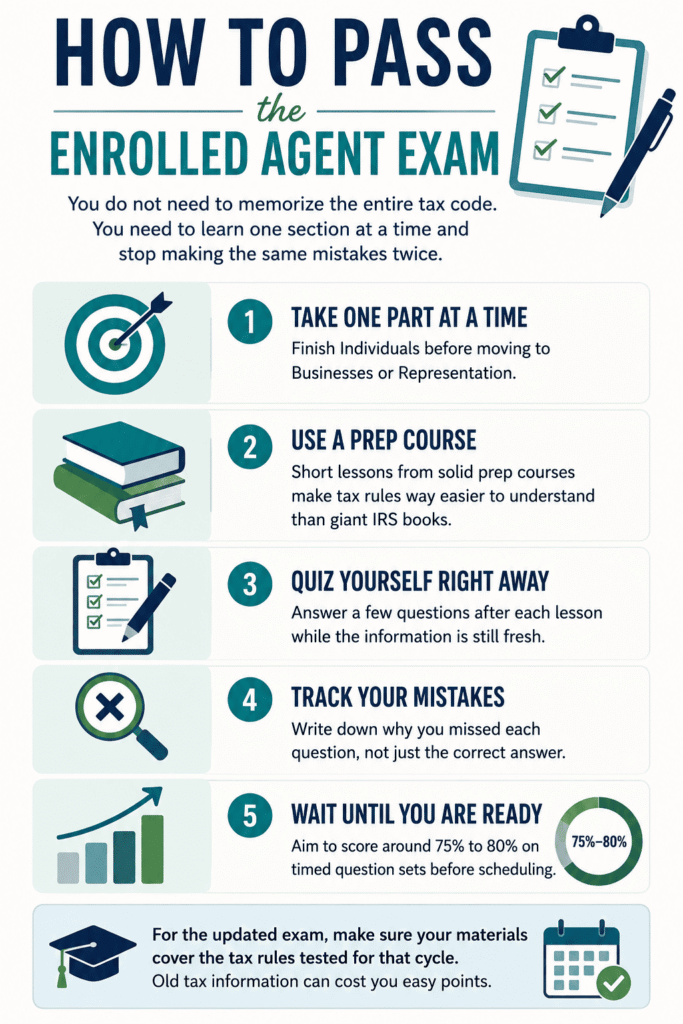
You do not need to memorize the entire tax code. You need to learn one section at a time and stop making the same mistakes twice.
- Take One Part at a Time: Finish Individuals before moving to Businesses or Representation.
- Use a Prep Course: Short lessons from solid prep courses make tax rules way easier to understand than giant IRS books.
- Quiz Yourself Right Away: Answer a few questions after each lesson while the information is still fresh.
- Track Your Mistakes: Write down why you missed each question, not just the correct answer.
- Wait Until You Are Ready: Aim to score around 75% to 80% on timed question sets before scheduling.
For the updated exam, make sure your materials cover the tax rules tested for that cycle. Old tax information can cost you easy points.
Simple Enrolled Agent Exam Study Schedule
Most people should prepare for one part at a time. Six to eight weeks per section gives you room to learn without dragging the process out forever.
Weeks 1–2: Learn the Main Rules
Follow your course or exam outline. Study one major topic each day and take short notes.
Weeks 3–4: Apply What You Learned
Answer the question sets after every topic. Start a missed-question log and review it several times each week.
Weeks 5–6: Fix Weak Areas
Spend less time on topics you already know. Focus on rules you confuse, calculations you miss, and forms you cannot recognize.
Final Week: Get Exam Ready
Complete timed sets, review your mistake log, and stop adding brand-new material at the last minute. Leave some space between exam parts. Passing one section is already a lot; you do not need to schedule all three back-to-back.
What Happens After You Pass?
Passing the exam is not the last time you will deal with the IRS. You must keep your enrolled agent status active.
- Renew Your EA Status: Renew every three years based on the last digit of your Social Security number.
- Renew Your PTIN: Your Preparer Tax Identification Number must be renewed every year by December 31.
- Complete Continuing Education: Earn 72 approved hours every three years, including six hours of ethics.
- Meet the Yearly Minimum: Complete at least 16 hours each year, including two ethics hours.
Is the Enrolled Agent Exam Right for You?
The EA exam may be a good fit if these sound like you:
- You Enjoy Tax Work: ➡️ The material connects directly to the career.
- You Want to Represent Clients: ➡️ Enrolled agents receive unlimited representation rights before the IRS.
- You Notice Tiny Details: ➡️ Small facts can completely change the correct tax answer.
- You Want a Federal Credential: ➡️ The EA credential is not limited to one state.
- You Hate Working With Rules and Forms: ➡️ This career may get frustrating very quickly.
- You Only Want to Prepare Basic Returns: ➡️ You may not need the full credential yet.
Is the Enrolled Agent Exam Worth Taking?
The Enrolled Agent Exam is worth it when you want tax to become a serious part of your career.
You do not need a specific degree, which makes the path more accessible than many professional credentials. The trade-off is learning a large amount of detailed federal tax information and keeping that knowledge current.
Do not approach it as one massive test. Treat each section as its own goal, use the official outline, and study through questions and real tax forms. Three smaller wins feel much more manageable than trying to conquer the entire tax code at once.
Compare the best EA prep courses before you choose a study plan.
FAQs
How Many Parts Are on the Enrolled Agent Exam?
There are three parts: Individuals, Businesses, and Representation, Practices and Procedures. You can take them in any order.
What Score Do You Need to Pass the Enrolled Agent Exam?
The current scaled passing score is 500. If you pass, your report shows a passing designation instead of a numeric score.
Can You Take the Enrolled Agent Exam Without Experience?
Yes. The IRS does not require previous tax work or a college degree before you take the exam.
Which Part of the Enrolled Agent Exam Is Hardest?
Many candidates find Part 2 difficult because it covers several business entities and a wide range of tax rules. Your hardest section will depend on your existing tax experience.
How Long Do You Have to Pass All Three Parts?
A passing section remains valid for three years from the date you passed it. You must complete the remaining sections before that credit expires.
Can You Retake a Failed EA Exam Section?
Yes. You may attempt each part up to four times during one testing window. You must schedule and pay for each new attempt.
Leave A Comment